Saturday, July 16, 2011

Jaguarundi


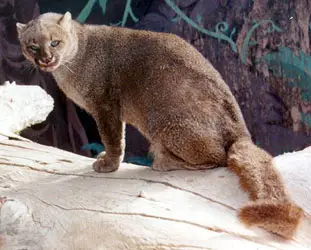
The Jaguarundi (Puma yagouaroundi) is a species of cat found in North and South America.  Because of the different color phases, people used to think that there were two different species: the grey one being called jaguarundi and the red one being called eyra.


Physical Features 
The jaguarundi is a medium sized cat.  In terms of physical appearance, it is the least cat-like of all felines and cats.  It has a long body, short legs and a long tail which makes it look like a otter or sometimes a marten.  As they look like an otter, they are sometimes called 'otter cats'.  They do not have any spots on their body and their color is same throughout or sometimes it may have some faint markings on the underside and face.  It has a total length of 54 to 74 cm out of which the tail is 32 to 52 cm long.  It weighs about 4.2 kilograms to 10.3 kilograms.  Jaguarundis can be brownish grey (grey phase) and foxy red to chestnut (red phase).


Behavior and Diet 
Jaguarundis are mainly diurnal, being active during mornings.  They normally hang around on trees but prefer hunting on ground.  They will almost eat any animal they catch like rodents, small reptiles and even ground feeding birds.  Jaguarundis may even eat larger pray like rabbits and some primates like marmosets, which is unusual for a wild cat. Like all cats, their diet consists of a small amount of vegetation of arthropods like scorpions.  Jaguarundis are rather cordial than other wild cats.  They can tolerate close presence of other animals.  They are usually found alone as they lead a solitary life.  Jaguarundis are shy and very cautious of man made traps.     


Distribution and Habitat
Range of  jaguarundis
Jaguarundis are found in North and South America.  In North America, they are found from southern Texas to coastal Mexico.  Their range runs through Central America and then into South America, where they are found east to the Andes.  Their range goes on till northern Argentina in the south of South America.  Jaguarundis prefer to live in lowland brush areas which has water nearby.  There are some sightings of them on elevations of 3200 meters high (10500 feet).


Conservation Status
Jaguarundis are not under any threat as of now.  They are rated as 'Least Concern' by IUCN.  They have a very wide range and therefore are not under threat.


Source of pic 1 and pic 2 

Sunday, June 19, 2011

Saiga


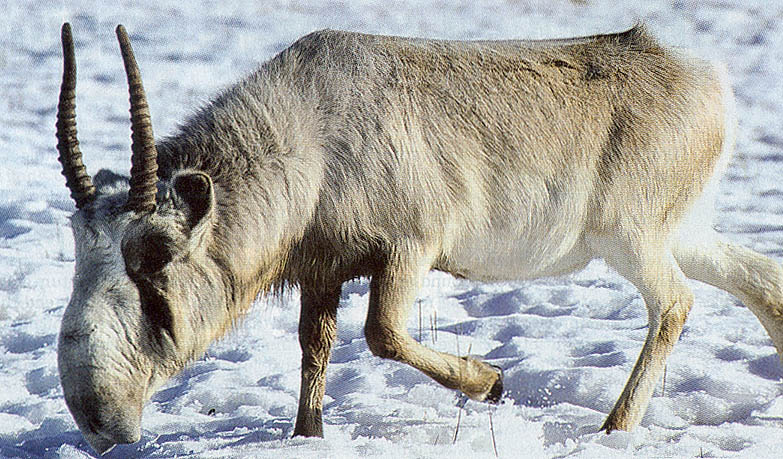
The saiga antelope (Saiga tatarica) or simply saiga, is a species of antelope found only in  Asia.  It is rated as 'critically endangered' by the IUCN.  It was found in many other places during the Ice Age.


Physical Features
A baby siaga
The weight of a saiga ranges from 39 kg to 65 kg.  They stand about 0.7 to 0.9 meters at the shoulder.  Males are normally bigger than females.  Males have horns while females do not have any.  Their horns are used for medicinal purposes.  Saigas have an unusual nose.  The nose is flexible and long.  Their nose warms up the air they inhale during winter and clears out the dust they inhale during summer.


Behavior and Diet
Saigas eat several species of plants, including some poisonous plants which other herbivores do not eat.  They live in large herds that can cover quite a long distance.  Saigas can swim across rivers and avoids rugged and steep terrain.  Their mating season starts at November,  where males (stags) will fight against each other for the females.  The winner will get to lead a group of 7 to 50 group of females.  In springtime, females give birth to young ones.   


Distribution and Habitat
The siaga is classified as critically endangered.  The population has reduced by 95% in the past 15 years.  They are currently found in three particular areas in Kazakhstan, two isolated places in Mongolia and in Kalmykia, Russia.  During the Ice Age, they were found in Alaska, North America, through the British Isles and Central Asia.  They live in semi-desert steppes.   


Conservation
In 1920, saigas were almost extinct.  But, by 1950, they were recovered and there were more than 2 million in USSR itself.  Today, only 50,000 are present globally in the wild and therefore, they are rated as critically endangered.  They are hunted as their horns have medicinal properties.  Since rhino hunting was banned, hunters started hunting saigas as their horns are equivalent to those of a rhino.  Currently, Moscow zoo is the only zoo that have these antelopes.


Source of pic 1 and pic 2   
Saturday, June 18, 2011

Binturong


The biturong (Arctictis binturong) also known as the Bearcat, Asian bearcat or the Palawan bearcat is a species from the family Viverridae which includes civets and genets.  The real meaning of the original word has been lost as a particular local language is extinct.  This species is classified as vulnerable as numbers have reduced due to destruction of habitat.


Physical Features 
As the binturong is an omnivore, people refer to it as a small bear but it is actually the size of a large cat.  It can grow 24 to 38 inches (60 to 96 cm) and can weigh about 14 kilograms.  Some  specimens are 24 kilograms or more.  They have coarse, black fur and has light silver fur on its face which makes it look larger to other animals.  It is a nocturnal and sleeps on branches during the day.  The tail is prehensile, bushy and is almost the length of the animal itself .  It can act like  a fifth hand for the animal.  Binturongs have small, round ears and eyes.


Diet
The binturong is an omnivore.  It feeds on leaves, fruits and seeds while it even feeds on insects, eggs, rodents or even birds.  This habit resembles a bear and therefore, it has earned its name 'bearcat' as it is like a large cat.


Behavior
The binturong jumps from branch to branch in search of food using its tail as support and its claws for grip.  They can use their tail to communicate as there are scent glands near the tail which sends a signal to other animals.  Many people say that the scent that they emit smells like warm buttered popcorn.  Binturongs make chuckling noises when happy while they make a high pitched wail when annoyed.  Sometimes, when they are conered by an animal or a hunter, they can be vicious.


 Distribution and Habitat
A baby binturong with its mother
Binturongs live on canopies of rainforests.  They are found in Sri Lanka, Bangladesh, Malaysia, Laos, Cambodia, Bhutan, India, Burma, Indonesia, The Philippines,  Thailand, Nepal, China and Vietnam.


Life Cycle 
Binturongs have a gestation period of 91 days.  Females mature at the age of 30 months while males mature after 27 months.  They have a lifespan of 20 years in captivity.  There was a specimen that lived for 26 years


Conservation
Binturongs are on demand as their fur is used for medical purposes.  It is hunted by locals for their meat.  They are even threatened as alien species are introduced to their habitat.


Source of pic 2

Friday, June 10, 2011

Sierra Madre Forest Monitor


The Sierra Madre forest monitor (Varanus bitatawa) is a species of monitor lizard found in Sierra Madre of Philippines.  It belongs to the genus Varanus.  It is also called the golden spotted monitor.  


Physical Features
The head of the Sierra Madre forest monitor
Despite growing more than 2 meters (6.6 feet), this lizard weighs only 10 kilograms.  These forest monitors are very brightly colored with stripes of yellow dots and flecks.  Their legs are blackish-blue in color.  The tail is alternately colored with green and black.


Behavior and Diet 
The Sierra Madre forest monitor belongs to the same family as the Komodo dragon.  Surprisingly, the Sierra Madre forest monitor, is a frugivorous unlike other monitors.  They spend a lot f time on trees, overlooking the forest floor.  It camouflages on trees so that it is not spotted by any predator.  Their diet consists of Pandanus fruit, figs, Pili nut fruits and the occasional a snail.  Scientists do not think they have venom as they are not carnivores and therefore it will be no use producing venom.


Discovery and Distribution
The Sierra Madre forest monitor has a limited range in an island called Luzon island.  Even though this monitor is 2 meters long, it was discovered only in 2010.  It was discovered by scientist Brown along with other scientists.  Brown says that it was not discovered all these years as the forests in Northern part of the Luzon island was not explored much.  Many people say it was already known to local hunters.


Source of pic 1 and pic 2

Saturday, May 21, 2011

Marsh Crocodile


The marsh crocodile (Crocodylus palustris) is a species of crocodile found in Asia.  It is also known as the 'Mugger' which means 'water monster'.  They are rated as 'vulnerable' by the IUCN.


Physical Features
The length of old, mature male marsh crocodiles range from 10 feet to a maximum of 16 feet.  The biggest marsh crocodile was 16.8 feet.  They weigh about 450 kilograms.  A marsh crocodile more than about 13 feet long is exceedingly rare.  They have 19 upper teeth on each side of their mouth.  An average female is 8 feet long while an average male is about 10.3 feet.  On their dorsal shield, they have 4 longitudinal series of scutes and sometimes they may even have 6 of these series of scutes.  The scales on the limbs have a ridge down the center (keeled).  Marsh crocodile can run up to 8 kph on land if they have to catch prey.  In water they are much faster, swimming in short bursts of 10 to 12 kph.  Otherwise, they cruise at a speed of 1.6 kph to 3.2kph.


Distribution and Habitat
Marsh crocs at CrocBank
The marsh crocodile is found in India, Pakistan, Iran, Bangladesh, Sri Lanka, Nepal and even in the southern tip of Iraq.  It is the only crocodillian found in Pakistan and Iran.  They are highly populated in India.  Marsh crocodiles are freshwater crocodiles and therefore are found in marshes, lakes, rivers and freshwater streams.  They are commonly spotted in man made reservoirs.  Although they live in freshwater, they have some tolerance in saltwater.  It is adapted to terrestrial life.  It is more closely related to the Cuban crocodile.  Many marsh crocodile are found in captivity.  In captivity, they are found in places like CrocBank (Chennai) and Amaravathi Sagar Crocodile Farm (Coimbatore District).


Diet
Marsh crocodiles feed on fish, small reptiles and mammals, such as turtles and monkeys respectfully.  Large males are known to eat deers such as Sambars that weigh about 225 kg.  They may even eat a 450 kg domestic water buffalo.  There are not many reports of them eating humans.  These crocodiles come on land to hunt at night.      

Thursday, April 28, 2011

Maned Wolf


The maned wolf (Chrysocyon brachyurus) is in South America.  It is locally known as "guará guazú" which means 'large fox.'  It is rated as Near Threatened by the IUCN.


Physical Features
Being the largest South American canid ( family of foxes, wolves, etc.), an adult stands 67 to 107 cm at shoulder height and weighs 20 to 245 kilograms.  The maned wolf referred to as 'The Red Fox on Stilts' as the color of its fur resembles to that of a red fox, though the maned wolf is larger.  They have very long and black legs.  Their fur may be reddish brown to golden orange on the sides.  As the name suggests, they have a black mane.  They have a white mark beneath their throat which is called 'bib'.  The maned wolf is also called the Skunk Wolf as its has a distinctive odor.


Distribution and Habitat
The maned wolf is found in the southern and central parts of Brazil.  They are even found in Paraguay, northern Argentina, Bolivia, eastern and northern parts of Andes and in south-eastern Peru.  They are very rare in Uruguay.  Maned wolves live in semi-open and open habitats such as grasslands, scattered bushes and trees.


Diet
The maned wolf is specialized in capturing medium and small sized prey mainly rodents, birds and other small mammals.  It is said that over 50% of their diet is vegetable matter such as tuber, sugarcane, etc.  In zoos, they are currently fed meat and dog chow as well as different fruits and vegetables.  Unlike other canids, such as gray wolves and African hunting dogs, the maned wolf does not hunt in packs.


Taxonomy
The maned wolf is not a fox, wolf, coyote,  jackal or a dog but it is a canid which makes it a very interesting animal.  It closest living relative is the bush dog.  They do not have any other closely related canid.  In 2009, the extinct Falkland Islands Wolf was the closest relative of the maned wolf in historical time, over 6 million years ago.


Source of pic 1    

Saturday, April 23, 2011

Axolotl


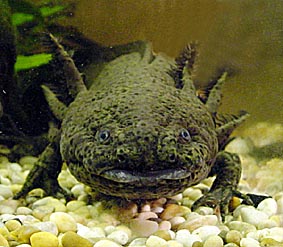
The axolotl ( Ambystoma mexicanum) is a species of amphibian.  It is also known as the water monster or the Mexican walking fish.  It is critically endangered  due to urbanization and polluted waters in Mexico.  Axolotl is even eaten by many locals.


Physical Features
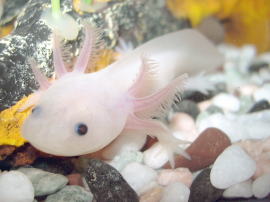
A leucistic axolotl 
A mature male axolotl can measure 15 to 45 cm long but many specimens can be 24 cm which is quite common.  As they are salamanders, they share many features with them like having external gills and a caudal fin that starts at the head and ends at the vent.  Males differ from females as the have a swollen cloaca.  Females look different from males they have wide bodies that are filled with eggs.  Axolotls have underdeveloped limbs that have thin and long digits.  They have a very wide head that contains lidless eyes.  There are three pairs of gill stalks present behind their head.  Below these gills, there are four pairs of gill slits.  They are often mistaken for mudpuppies, tiger salamanders and waterdogs.


Diet
Being a carnivorous, axolotls eat small prey such as worms, small fish and different insects.  They detect their food with the help of smell and will 'snap', any potential food.  It will suck its pray to its stomach with vacuum force.


Distribution and Habitat
Axolotls live in a high altitude body of water that is surrounded by terrestrial surface which can by risky.  They are found in Mexico which is in North America.  Axolotl are only native to  Lake Xochimilco and Lake Chalco which is present in central Mexico.


Conservation Status
The axolotl is rated as critically endangered by the IUCN.  The Mexican tiger salamanders breeds and lives in the same place as axolotls, which is a threat for them.  They no more exist in Lake Chaclo as the lake itself was artificially drained to avoid periodic floods.  Now, Lake Xochimilco is a diminished glimpse of its former self and has mainly canals present in it.  Axolotls were in the diet of many locals, but now, fewer locals eat them.


Source of pic 1 and pic 2