Thursday, July 26, 2012

Big Four Snakes of Asia

The Big Four snakes of Asia are the snakes which inflict the most snake bites in Asia, especially in the southern parts.  The Big Four includes:

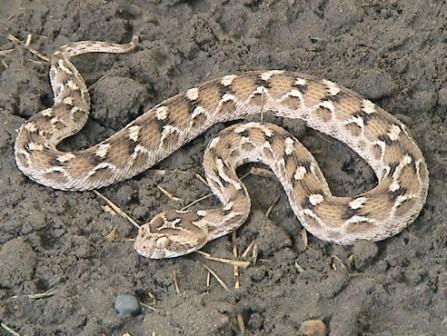
  • The saw-scaled viper
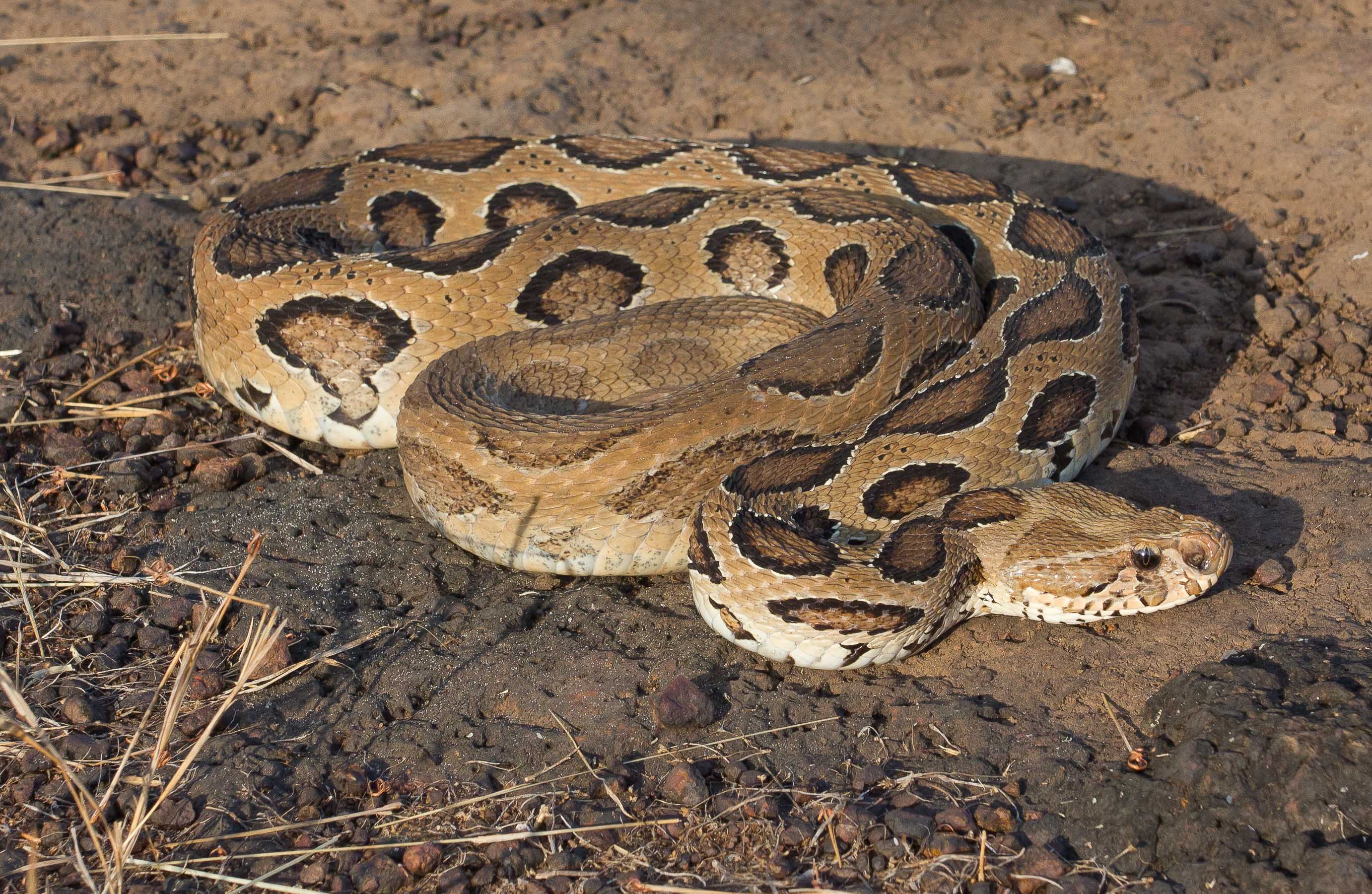
  • The russell's viper
  • The Indian cobra
  • The common krait
                                                     1. The saw scaled viper
                                                                           

The saw scaled viper (Echis carinatus) is considered to be one of the most aggressive snake in the world.  They are from the family of vipers (Viperidae).  These snakes are quite small.  Their length ranges from 30 cm (11 inches) to 65 cm (25 inches).  Saw scaled vipers are found in the Indian subcontinent (Sri Lanka, India, Pakistan and Bangladesh), Middle-East Asia and Central Asia.


                                                       2.  The russell's viper
                                                                          

The russell's viper (Daboia russelii) is a species of viper.  It causes the most deaths by any snake in Asia.  The word 'Daboia' means hidden or a lurker in Hindi.  A russell viper ambushes its prey.  Its skin allows it to camouflage with the background.  These snakes produce neurotoxin which affects the nervous system, causing paralysis.  Russell's vipers are found in India, Bangladesh, Pakistan, Sri Lanka, Laos, Myanmar, Thailand, China, Cambodia and parts of Indonesia.

                                                           
                                                         3. The Indian cobra

The Indian cobra (Naja naja) is a species of cobra and belongs to the Elapidae family. The Indian cobra is also known as the spectacled cobra. It got its name from the shape on its hood. The hood has two oceli that is connected by a curved line. This shape looks like spectacles. The Indian cobra is mainly found in the Indian subcontinent. These snakes rarely exceed the lengths of 8 or 8.5 feet. An average spectacled cobra is 6 feet long.


                                                        4. The common krait

                                                                       
The common krait (Bungarus caeruleus) is an elapid found in the Indian subcontinent. It is also known as the Indian krait or the blue krait. It has a body that is blue, black or brown. They ahve white bands on their body. Common kraits are considered to be 15 times more venomous than cobras. They are one of the most deadliest snakes in the world.


Source of pic 1, pic 2, pic 3 and pic 4

Thursday, May 17, 2012

Fisher


The fisher (Martes pennanti) is a species of mammal from the mustelid family. It resembles many species of marten but it is slightly larger. Its name is derived from many languages, one of them being Latin. They are rated as 'Least Concern' by the IUCN.


Physical Features
The fisher is a cat-sized animal with lustrous fur. The underside of its body have white or light brown patches. Like most species from the mustelid family, the coloration of the fur depends on seasons and gender. Fishers greatly vary in size. The length of their body ranges from 16 inches to 30 inches (40.6cm to 76.2cm) excluding the tail. The average length of their tail is 14 inches to 17 inches (35.5cm to 43.1cm). Males are normally bigger than females. Males weigh about 4.5 kilograms while females weigh about 2 kilograms. Sometimes males can weigh 9 kilograms but it is very rare.

Diet
The fisher is mainly carnivore, but will feed on anything. Their diet mainly consists of the snowshoe hare, porcupines and other small rodents. They are solitary hunters. Therefore, they will only feed on animals that are smaller or equal to its size. Fishers also eat fruits, nuts, mushrooms, small mammals, birds, insects and eggs. Pieces of deer and moose have also been found in the stomach of these animals.

Distribution and Habitat
The fisher is found in Northern US and Canada. Their range extends till the mountainous regions. Fishers prefer to live in forest and swamp woodlands.

Breeding
After a gestation period of 352 days, a female fisher will give birth to a litter of 1 to 5 pups per year after the spring season. Females mature at the age of 1 year while males mature at the age of 2. The live for 10 years in captivity and wild.

Conservation Status
The fisher is rated as 'Least Concern' by the IUCN. There are several thousands of individuals in North America. Fishers are protected in some US states.

Source of pic 1

Saturday, March 31, 2012

10 Weirdest Animals In The World


SQUID WORM

This is a squid worm.  At first when discovered in 2010, scientists couldn't tell if it was a worm or a squid.  It is now the first member of a new family in the class Polychaeta of segmented worms.

ANGORA RABBIT
  
The angora rabbit is a domestic breed of rabbit.  It is known for the amount of soft and long fur it has on its body.  It is one of the oldest type of domestic rabbit.

                                                              BLOBFISH

This repulsive looking creature is a blobfish which inhabits the deep waters off the coasts of Australia.  Its jelly-like body allows it to float in water.  It swallows any edible matter that comes in its way.
                                                                 
                                                        DUMBO OCTOPUS


The dumbo octopus get its name as its ears resemble the ears of the character 'Dumbo' in a movie by Walt Disney.  They are very rare. 
                                
                                                             RED UAKARI


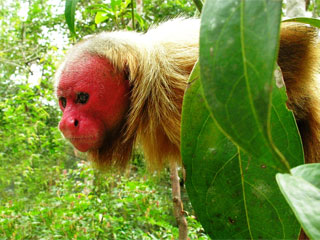
The red uakari is a primate.  It is known for its red face.  It is found in the rainforests of the Amazon.  
                                     
                                                          GIRAFFE WEEVIL


The giraffe weevil is a species of weevil native to Madagascar.  It is known for its unusually long neck which gives it this name.


GLASS FROG


The glass frog is one of the most fascinating amphibians in the world.  Its transparent skin allows one to see what is going on inside the body.  The organs of the frog are visible in this picture.


                                                          KOMONDOR DOG


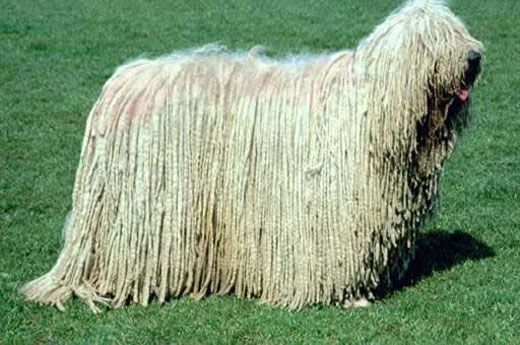
The komondor dog is a very unique dog.  It has unusually long hair which resemble dreadlocks.  It has the most amount of hair of any canine in the world.


CYCLOPS SHARK


The cyclops shark is a very rare shark found in Mexico.  It has a single functioning eye on the center of its head.


MARSUPIAL MOLE


The marsupial mole is a marsupial which is seen very rarely.  Details of its breeding is hardly known as it is very difficult to see.  It is considered to be endangered.

Saturday, February 11, 2012

Markhor


The markhor (Capra falconeri) is a species wild goat from the genus of Capra. It is rated as ''Endangered'' by the IUCN. It is found in Asia. It is the national animal of Pakistan.
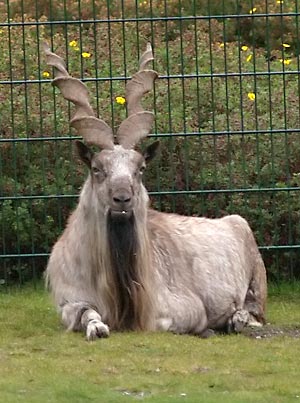
Male markhor


Physical Features
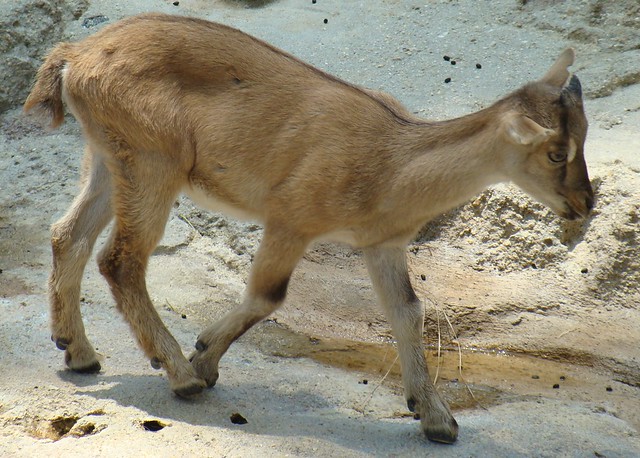
The markhor is the tallest species of wild goat by its shoulder height. The markhor stands about 30 to 48 inches tall (76 cm to 121 cm) at the shoulder. The length of this wild goat ranges from 4 feet to 6 feet. They have very lengthy horns which grow 5 feet long in males. The horns of females are much smaller than males. Their horns grow up to only 25 centimeters. Male markhors weigh 110 kilograms while females weigh only 40 kilograms. The main difference between male markhors and female markhors is the shaggy throat. Males have beard-like hair dangling from their chin. Both males and females have corkscrew-like horns. In summers, the fur of the markhor becomes shorter and reddish-grey in color.

Female markhor


Distribution and Habitat
The markhor is located in central and south of Asia.  It is found in the countries of Afghanistan, Pakistan, India, southern parts of Uzbekistan and some parts of Tajikistan.  The markhor is found in Gilgit-Baltistan, Hunza-Nagar Valley, northern and central Pakistan, and some parts of Jammu and Kashmir.  Markhors live in mountainous regions.  They live at astonishing heights of 700m to 4000m (2,300 feet to 13,200 feet).  Markhors live in the sparsely wooded parts of western Himalayas.  The markhor is an endangered goat with fewer than 2,500 individuals remaining.


Diet
The diet of markhors depend on the season in the mountains.  In summer, they eat tussock grass.  During winter, they will eat shrubby leaves and twigs which are found on the lower slopes of the mountains.


Conservation Status
The markhor is rated as 'Endangered' by the IUCN. There are only 2500 individuals of this goat found in the mountains of Asia.  Markhors are bred in many zoos all around the world.


Source of pic 1, pic 2, pic 3

Saturday, December 10, 2011

Bactrian Camel


The bactrian camel (Camelus bactrianus) is a species of camel. It like other species of its genus, is an even toed ungulate. It is rated as ''Critically endangered'' by the IUCN.

Physical Features
A bactrican camel measures 8 to 11 feet( 2.42 to 3.5 meters) in length, excluding the tail. The tail can be as long as 22 inches (55cm). The height of this camel can range from 6.5 feet to 7.5 feet( 1.96 to 2.3 meters). The bactrian camel weighs more than 600 kilograms. They have legs and a long neck like many animals from its genus. The bactrian camel has two humps on its back. This is why it is also called the two humped camel. The bactrian camel has large eyes and round ears which are small. The have two toes on each leg.

Diet
The bactrian camel is mainly a herbivore. They feed on plant material. A very thirst camel can drink 135 liters of water in 13 minutes.

Distribution and Habitat
The bactrian camel is found in Asia. They are located in the northwestern parts of China and Mongolia. They are also found in remote regions of the Gobi Desert. The bactrian camel may be found in steppes, deserts and rocky scrublands.

Behavior
The bactrian camel is quite social. It lives in herds which are called caravans. These camels are non-territorial. They are diurnal. this means they are active only during the days.

Conservation Status
The bactrian camel is endangered in wild, with a population of about 1000 individuals. Otherwise, these camels have a population of 2 million which has been domesticated.

Source of pic 1 

Thursday, October 20, 2011

European Marmot


The European marmot (Marmota marmota) is a species of marmot found only in Europe. It is also known as the alpine marmot.


Physical Features
The European marmot has a stocky body.  They weigh about 3 to 4 kilograms.  These animals measure about 20 inches (52 cm) excluding their tail.  Their tail measures about 8 inches (20 cm).  The European marmot generally has short and muscular legs.  Their fur is golden-brown in color.  This species of marmot has a short tail.  The European marmot is the largest squirrel species.


Taxonomy
The European marmot belongs to the squirrel family of Sciuridae.  They belong to the order of Rodentia.


Behavior
European marmots are diurnal. They rest at night but are active in the day.  European marmots hibernate for approximately 7 months a year.  They produce a shrill whistle when they are alarmed.  They even growl and screech when they are angry.


Distribution and Habitat
The European marmot is found in the alpine regions of Switzerland, France and Italy.  They have been re-introduced to the Carpathian Mountains which is located on the border of Slovakia and Poland.  They are also found in parts of Germany.  They live in alpine meadows and in rocky slopes with an elevation of about 1,970 feet (600 meters).  They build burrows which are very complex, digging with their forepaws, while their hind legs also help in digging.  Their forepaws will scrape away the soil and the hind legs will keep the soil aside.  Each burrow will have only one family which has a dominant breeding pair.  The same burrow may be used by the next generation.  While digging the tunnel, the European marmot will sometimes use its teeth to remove some small stones.


Diet
A European marmot in summer.
European marmots are omnivores.  They will eat plants such as herbs and shrubs.  Spiders and other insects are also eaten by these marmots. European marmots will prefer to eat tender and young plants of any species.  They hold their food in their forepaws while eating.  Before hibernating in winter, they eat a lot a food which provides them with fat.


Conservation Status
European marmots are not threatened at the moment.  They are abundant in their current range. Their population had declined in the 20th century, but now they have successfully been re-introduced to the respective range.


Source of pic 1 and pic 2

Sunday, October 16, 2011

Przewalski's Horse


The przewalski's horse (Equus ferus przewalskii) is a species of horse found in Asia.  It is considered as 'critically endangered' by the IUCN.  It is also known as the Dungarian horse and has recently been introduced to the wild.

Physical Features
The przewalski's horse closely resembles a domesticated horse.  Its fur is a dull grayish brown in color.  The przewalski's horse stands about 4.3 feet tall (52 inches) and measures 2.1 meters in length (6.11 feet).  Its fur has some pangarĂ©  features.They have a dark brown color around the mane on the neck and a pale brown color on the flanks and a yellowish white color on the belly and around the muzzle.  They have shorter legs than feral horses and have faint stripes on their body.  These horses can weigh more than 310 kilograms.


Diet
The przewalski's horse is mainly herbivorous, eating grass.  Some of these horses rest in salt licks to obtain enough minerals.  Przewalski's horses need a lot of nutrients everyday as they travel more than six miles per day with their group.

Behavior
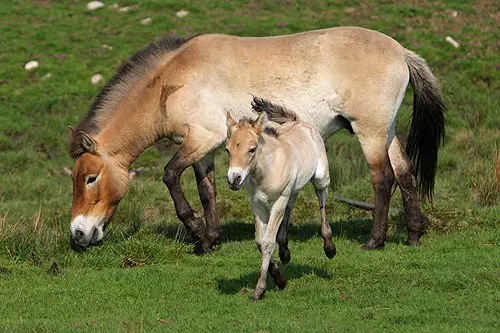
A female horse with its offspring.
The behavior of a przewalski's horse resembles the behavior of a domesticated horse.  They live in groups which consists of a stallion, who leads the group and mares with their offsprings.  The przewalski's horse is diurnal; they are active only during the day.  At night, they all sleep together for about four hours.

Distribution and Habitat
The przewalski's horse is foound in the steppes of Mongolia and China, Asia.  They were once extinct in the wild but were re-introduced.

Conservation Status
The przewalski's horse was extinct in the wild but were introduced to Khustain Nuruu National Park, Takhin Tal Nature Reserve and Khomiin Tal, which contains their natural habitat.  These national parks are in Mongolia.  In 2005, the population of these horses were 1500 which include individuals in wild and in captivity but the population has increased since then.  They are rated as 'critically endangered' by the IUCN.  

 Source of pic 1 and pic 2