Saturday, April 23, 2011

Axolotl


The axolotl ( Ambystoma mexicanum) is a species of amphibian.  It is also known as the water monster or the Mexican walking fish.  It is critically endangered  due to urbanization and polluted waters in Mexico.  Axolotl is even eaten by many locals.


Physical Features
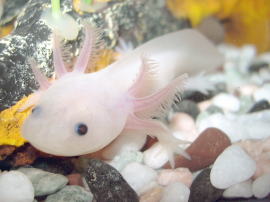
A leucistic axolotl 
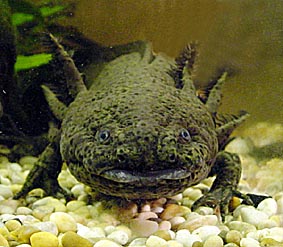
A mature male axolotl can measure 15 to 45 cm long but many specimens can be 24 cm which is quite common.  As they are salamanders, they share many features with them like having external gills and a caudal fin that starts at the head and ends at the vent.  Males differ from females as the have a swollen cloaca.  Females look different from males they have wide bodies that are filled with eggs.  Axolotls have underdeveloped limbs that have thin and long digits.  They have a very wide head that contains lidless eyes.  There are three pairs of gill stalks present behind their head.  Below these gills, there are four pairs of gill slits.  They are often mistaken for mudpuppies, tiger salamanders and waterdogs.


Diet
Being a carnivorous, axolotls eat small prey such as worms, small fish and different insects.  They detect their food with the help of smell and will 'snap', any potential food.  It will suck its pray to its stomach with vacuum force.


Distribution and Habitat
Axolotls live in a high altitude body of water that is surrounded by terrestrial surface which can by risky.  They are found in Mexico which is in North America.  Axolotl are only native to  Lake Xochimilco and Lake Chalco which is present in central Mexico.


Conservation Status
The axolotl is rated as critically endangered by the IUCN.  The Mexican tiger salamanders breeds and lives in the same place as axolotls, which is a threat for them.  They no more exist in Lake Chaclo as the lake itself was artificially drained to avoid periodic floods.  Now, Lake Xochimilco is a diminished glimpse of its former self and has mainly canals present in it.  Axolotls were in the diet of many locals, but now, fewer locals eat them.


Source of pic 1 and pic 2 

Saturday, April 16, 2011

Western Hognose Snake


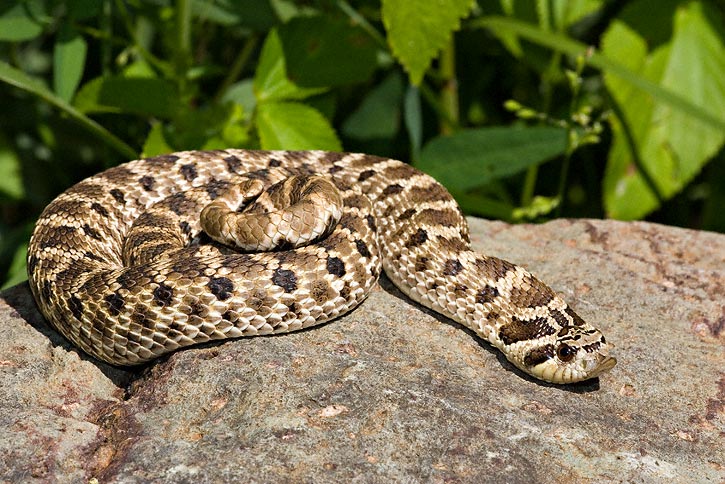
The Western Hognose Snake (Heterodon nasicus) is a species of snake found in North America.  It is a colubrid and therefore is not very venomous. 


Physical Features
The nose of a Western Hognose Snake.
The Western Hognose Snake measures 45cm to 90cm.  Their body color is normally brown but can appear to be yellowish due to the blotches on its back.  They have an inky black, yellow or white checker pattern on their belly.  While shedding their skin, they act more aggressive as they cannot see while shedding.  Their snout is pointed and turned upwards.  They have a stocky body and their scales are heavily keeled.  Their necks are quite thick.  Western Hognose snakes are rear fanged and their venom does not pose any threat to humans.  The Eastern Hognose snake has a less upturned snout and more squarer blotches and therefore are different from Western Hognose snakes.


Distribution and Habitat
The Western Hognose snake is found in North America.  They are found in the central states of America.  They are even found in the southern part of Canada and northern part of Mexico.  Western Hognose snakes can be found in human surroundings, drained short-grass prarie, rocky semi-deserts and deserts, wood edges and fields and chaparrals.


Diet
Western Hognose snakes are mainly carnivores.  They eat different amphibians like toads and frogs.  They even eat reptile eggs, lizards, snakes and birds.


Life Cycle
Western Hognose snakes are oviparous and can lay 4 to 23 eggs between the months of June and August.  The hatchlings reach maturity after two years.  The eggs take 60 days to hatch.


Conservation Status
The Western Hognose snake is rated as Least Concern on the IUCN Red List of Threatened Species.  This means that they are not endangered and are high in numbers.  However, the are considered as endangered in the state of Iowa and are threatened in the states of South Dakota and Illinois.


Source of pic 1 and pic 2

Monday, April 11, 2011

Leafy Sea Dragon


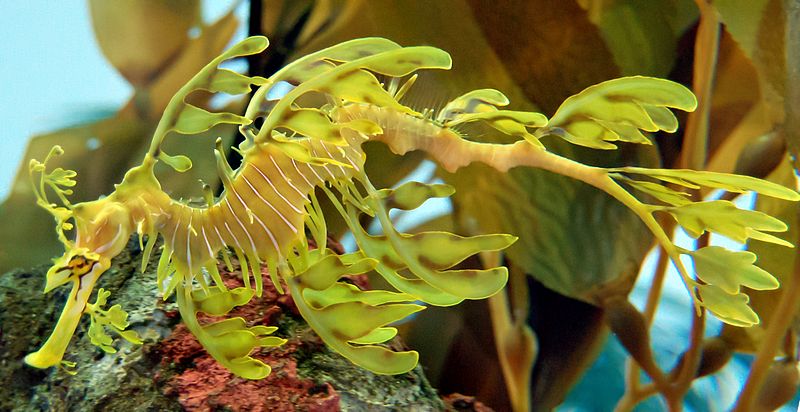
The leafy sea dragon (Phycodurus eques) is a species of marine fish from the same family of sea horses.  They are good at camouflaging.  The are rated as ''Near Threatened'' by the IUCN.  It is also known as the Glauerts sea dragon.

Physical Features
The leafy sea dragon is not large, but it is larger compared to other sea horses, growing about 20 to 25 cm.  They get their name from the mythological creature, the dragon.  The leafy sea dragon has leaf like protrusions all over the body.  These protrusions are used to camouflage.
Leafy sea dragon camouflaging
Leafy sea dragons move with the help of a dorsal fin, which is close to the tail end and the pectoral fin which is located on the ridge of the neck.  The leaf like protrusions help to camouflage even while moving and therefore, they look like a piece of floating sea weed.  Leafy sea dragons can even color blend but it depends on diet, age, location and stress level.

Diet
Leafy sea dragons mainly feed on plankton and different types of crustaceans with a long, pipe like snout.  Their diet even consists of shrimps and small fish.  They do not have any teeth which is very rare among all animals which eat small fish or shrimps.  This creature catches its prey with the help of camouflaging.

Threats
Leafy sea dragons have many threats.  These threats are humans or natural predators and even different natural calamities.  As leafy sea dragons are very slow swimmers, it is difficult for them to escape from predators.  They sometimes caught by fishermen.  Unlike sea horses, sea dragons cannot curl their tail around grasses and therefore are washed to sore by storms.  They are even affected by increasing pollution in water.

Distribution and Habitat
The leafy sea dragon is found only in the waters of Kangaroo Islands, Australia on the Southern shoreline of the Jurien Bay.  They were once thought to have a very limited range but scientists have found out that they may travel several hundred meters from their original habitat and then will return to the same spot.  Leafy sea dragons are commonly spotted by scuba divers in Adelaide.  They are found around clumps of sand, hiding behind rocks and sea weeds at a depth of 50 meters.

Source of pic 1 and pic 2

Friday, April 8, 2011

Yeti Crab


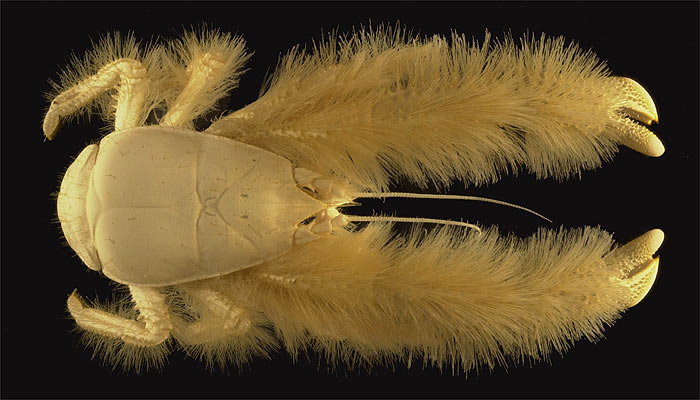
The yeti crab (Kiwa hirsuta) is a species of crab discovered in 2005.  It is a crustacean that was found in the South Pacific Ocean.  This decapod is also called the yeti lobster.


Physical Features
Yeti crabs have very small eyes that have very less pigment.  This crustacean is about 15 cm long (5.9 inches).  The yeti crab is unique for the quantity of silky, blond setae (which is like fur) on its thoracic legs.  They are believed to be blind.  The pincers of yeti crabs have hair which contain filamentous bacteria.  They use these bacteria to detoxify the poisonous minerals in the water.  These crabs eat bacteria, even though they are thought to be carnivores.  Yeti crabs are referred to as furry lobsters but are more closely related to hermit crabs.


Identification
In 2005,  Robert Vrijenhoek of the Monterey Bay Aquarium Research Institute in Monterey, California organized a group along with Michel Segonzac of Ifremer.  Together, this group found the yeti crab, using submarine DVS Alvin.  The discovery of the yeti crab was announced on the 7th March of 2006.  It was found along the Pacific-Antarctic Ridge which is 1500 kilometers (900 miles) south of the Eater Island, which is near the islands of Polynesia, near New Zealand.  It was found at a depth of 7200 feet, living on  hydrothermal vents.


Etymology
The genus name, Kiwa, is named after the goddess of shellfish on Polynesian mythology.  Whereas, in Maori, the mythology of New Zealand, Kiwa means the male guardian of the sea.  In Latin Hirusta means hairy.


Source of pic 1  

Thursday, March 24, 2011

Stump Tailed Skink


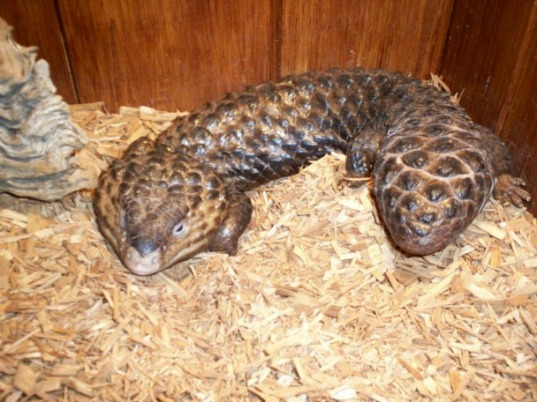
The stump tailed skink ( Trachydosaurus rugosus) is a species of skink found in Australia.  It is even found on the Rottenest island.  It is locally common and not threatened.


Physical Features
Tongue of a stump tailed skink
The stumped tailed skink can vary in size.  Some are 41 cm and some can be almost 50 cm.  They are very heavily built and have a triangular shaped head unlike many lizards and skinks.  They have very minute ear openings and very short legs which make them different from most of the other species of lizards and skinks.  Some types of stump tailed skinks have a short and blunt tail which resembles the head.  Most of their predators and prey get confused due to the resemblance of the head and tail.  Their large scales are rough and knobby.  Like the blue tongue skink, the stump tailed skink also has a blue tongue.  Their body color can vary from dark brown to black.


Diet
The stump tailed skink is mainly omnivorous.  The regularly eat vegetables and plants but eat snails, insects and carrion also.


Distribution and Habitat
The stump tailed skink's main habitat is dry woodland and semi-arid areas.  They are mainly found in Southern Australia from New South Wales to the coast of the state Western Australia.  They are aslo found in the Rottenest island off coast of Western Australia.


Breeding
Females reproduce 1 to 2 young each year with a gestation period of 5 months


Common names
The other names for the stump tailed skink are-
Boggi which is a local name, sleepy lizard, pine cone lizard, bob tailed lizard and shingleback lizard.


Conservation Status
The stump tailed skink is currently not threatened and is not listed as a threatened species in IUCN.


Source of pic 1 and pic 2

Saturday, March 19, 2011

Crocodile Skink


The crocodile skink (Tribolonotus gracilis) is a species of skink found in Papua New Guinea, near Australia.  Their head resembles a head of a crocodile and therefore is named the crocodile skink.They are rated as 'vulnerable' by IUCN.


Physical Features
The crocodile skink measures about 8 inches (20 cm).  They weigh about 500 grams.  Their heads are triangular in shape and has a casque at the rear.  The scales on their tail awkwardly point backward.  They have big and spiny scales along their back like crocodiles have.  These skinks have a body color of brown on the back and have a yellowish brown color in the underside.There is always and orange ring type outline around their eyes.  There is a yellow pigment present on the anterior edge of their eyes.


Diet
Crocodile skinks are omnivorous.  They eat both plants and insects.  They will prefer eating insects on plants but sometimes eat plants when insects are scarce.


Life Cycle
Female crocodile skinks lay on egg and occasionally two eggs.  The eggs hatch after 65 to 75 days.Several clutches of eggs are laid during the correct season.  Males protects the eggs while females go out in search of food for themselves.


Distribution and Habitat
The crocodile skink lives in coconut plantations and forests which are close to water or some wetland.  they are only found in New Guinea.


Source of pic 1 

Friday, March 4, 2011

Kokako


The kokako (Callaeas cinerea) is a species of forest bird found in few islands in New Zealand and near it.  It is endangered due to introduction of alien species and habitat loss.  It is one of the three species of the wattlebird family, the others being the extinct huia and the endangered tieke.


Physical Features
The kokako is like a pigeon, measuring 39 cm (15 inches) and has a wingspan of 48 cm (19 inches).  They weigh 227 grams and have longer legs than pigeons.  Compared to pigeons, they have longer tails but shorter wings.  They have blue wattle folds beneath their beaks with make them different and recognizable.  Their feathers are steel gray and they have a jet black face mask.  Immature kokakos do not have light face masks and lack the wattles.  The South Island kokako has orange wattles with only a patch of blue.


Diet                                                                               
Kokako feeding on berries
The kokako feeds on leaves, berries, mosses, ferns, cones and they even eat insects in necessary.  They always pluck their food with the help of only one claw.


Behavior
The kokakos are poor flyers.  They prefer to leap from one branch to the other with their powerful and long legs.  Koakos making terrific calls.  Their calls can be heard from meters away.  Mating pairs normally sing a duet song for one hour in the morning.  They can maximum fly for 100 meters continuously and then they glide.  They are normally compared to a flying squirrel


Life Cycle
Kokakos make nests of twigs and mosses where they lay their eggs.They lay up to 3 eggs.  The eggs have an incubation period of 20 days and the young fledge after 30 days.


Distribution and Habitat
The kokakos are found in the North Island and Great Barrier island of New Zealand.  They are considered to be extinct in the South Island.  They prefer to live in lowland and mountain forests in New Zealand.  Kokakos are endemic to New Zealand.


Conservation Status
The kokakos are endangered in many parts of its range.  It is considered to be extinct in the South Island.  It recently has been introduced to 3 islands in New Zealand.  Their are estimated fewer than 400 pairs remaining in the world.  They are mainly endangered due to habitat loss as people cut them down for timber.


Source of pict 1 and pict 2