Thursday, March 24, 2011

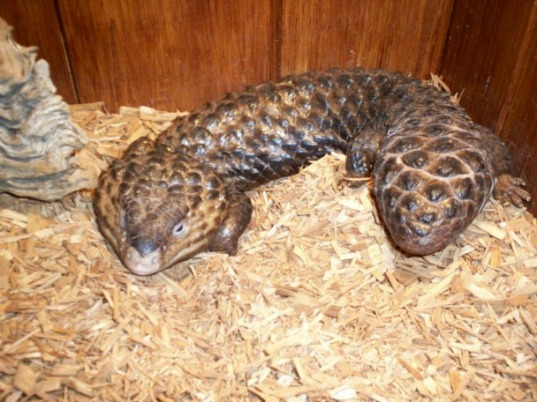
Stump Tailed Skink


The stump tailed skink ( Trachydosaurus rugosus) is a species of skink found in Australia.  It is even found on the Rottenest island.  It is locally common and not threatened.


Physical Features
Tongue of a stump tailed skink
The stumped tailed skink can vary in size.  Some are 41 cm and some can be almost 50 cm.  They are very heavily built and have a triangular shaped head unlike many lizards and skinks.  They have very minute ear openings and very short legs which make them different from most of the other species of lizards and skinks.  Some types of stump tailed skinks have a short and blunt tail which resembles the head.  Most of their predators and prey get confused due to the resemblance of the head and tail.  Their large scales are rough and knobby.  Like the blue tongue skink, the stump tailed skink also has a blue tongue.  Their body color can vary from dark brown to black.


Diet
The stump tailed skink is mainly omnivorous.  The regularly eat vegetables and plants but eat snails, insects and carrion also.


Distribution and Habitat
The stump tailed skink's main habitat is dry woodland and semi-arid areas.  They are mainly found in Southern Australia from New South Wales to the coast of the state Western Australia.  They are aslo found in the Rottenest island off coast of Western Australia.


Breeding
Females reproduce 1 to 2 young each year with a gestation period of 5 months


Common names
The other names for the stump tailed skink are-
Boggi which is a local name, sleepy lizard, pine cone lizard, bob tailed lizard and shingleback lizard.


Conservation Status
The stump tailed skink is currently not threatened and is not listed as a threatened species in IUCN.


Source of pic 1 and pic 2

Saturday, March 19, 2011

Crocodile Skink


The crocodile skink (Tribolonotus gracilis) is a species of skink found in Papua New Guinea, near Australia.  Their head resembles a head of a crocodile and therefore is named the crocodile skink.They are rated as 'vulnerable' by IUCN.


Physical Features
The crocodile skink measures about 8 inches (20 cm).  They weigh about 500 grams.  Their heads are triangular in shape and has a casque at the rear.  The scales on their tail awkwardly point backward.  They have big and spiny scales along their back like crocodiles have.  These skinks have a body color of brown on the back and have a yellowish brown color in the underside.There is always and orange ring type outline around their eyes.  There is a yellow pigment present on the anterior edge of their eyes.


Diet
Crocodile skinks are omnivorous.  They eat both plants and insects.  They will prefer eating insects on plants but sometimes eat plants when insects are scarce.


Life Cycle
Female crocodile skinks lay on egg and occasionally two eggs.  The eggs hatch after 65 to 75 days.Several clutches of eggs are laid during the correct season.  Males protects the eggs while females go out in search of food for themselves.


Distribution and Habitat
The crocodile skink lives in coconut plantations and forests which are close to water or some wetland.  they are only found in New Guinea.


Source of pic 1 

Friday, March 4, 2011

Kokako


The kokako (Callaeas cinerea) is a species of forest bird found in few islands in New Zealand and near it.  It is endangered due to introduction of alien species and habitat loss.  It is one of the three species of the wattlebird family, the others being the extinct huia and the endangered tieke.


Physical Features
The kokako is like a pigeon, measuring 39 cm (15 inches) and has a wingspan of 48 cm (19 inches).  They weigh 227 grams and have longer legs than pigeons.  Compared to pigeons, they have longer tails but shorter wings.  They have blue wattle folds beneath their beaks with make them different and recognizable.  Their feathers are steel gray and they have a jet black face mask.  Immature kokakos do not have light face masks and lack the wattles.  The South Island kokako has orange wattles with only a patch of blue.


Diet                                                                               
Kokako feeding on berries
The kokako feeds on leaves, berries, mosses, ferns, cones and they even eat insects in necessary.  They always pluck their food with the help of only one claw.


Behavior
The kokakos are poor flyers.  They prefer to leap from one branch to the other with their powerful and long legs.  Koakos making terrific calls.  Their calls can be heard from meters away.  Mating pairs normally sing a duet song for one hour in the morning.  They can maximum fly for 100 meters continuously and then they glide.  They are normally compared to a flying squirrel


Life Cycle
Kokakos make nests of twigs and mosses where they lay their eggs.They lay up to 3 eggs.  The eggs have an incubation period of 20 days and the young fledge after 30 days.


Distribution and Habitat
The kokakos are found in the North Island and Great Barrier island of New Zealand.  They are considered to be extinct in the South Island.  They prefer to live in lowland and mountain forests in New Zealand.  Kokakos are endemic to New Zealand.


Conservation Status
The kokakos are endangered in many parts of its range.  It is considered to be extinct in the South Island.  It recently has been introduced to 3 islands in New Zealand.  Their are estimated fewer than 400 pairs remaining in the world.  They are mainly endangered due to habitat loss as people cut them down for timber.


Source of pict 1 and pict 2

Wednesday, February 9, 2011

Black-Footed Ferret


The black-footed ferret (Mustela nigripes) is a carnivorous found in North America.  It is closely related to the steppe polecat from Russia.  They were thought to be extinct for a long time until few individuals were found and raised.  Now, is classified as endangered.


Physical Features
Black footed ferrets are small carnivores, reaching a length of 55 cm(24 inches).  They have very furry tails which measure 15 cm (6 inches).  They weigh about 1.2 kilograms and as the name suggests, they have black feet and short legs.  Like all the members of their family, black footed ferrets have elongated bodies.  Even though they white as the base color of their fur, their fur appears to be yellowish-brown as it darkens at the white darken at the tips.  The tip of their tail is black in color and they have a face mask-like outline around their eyes.


Diet
The black footed ferret is a carnivore like all ferrets.  They eat insects, lizards and other small invertebrates.  Their diet mainly consists of prairie dogs, eating about 100 per year.  They even prey on birds and small mammals.


Distribution and Habitat
The black footed ferret has greatly reduced in numbers.  It once was present in many parts of the United States of America and Canada.  But know, it is thought to be extinct in Canada and is present in three protected territories in USA.  They live in burrows.


Conservation Status
The black footed ferret was thought  to be extinct for sometime until, some scientists, in 1981 found a population of 131 individuals near a town named Meeteetse, Wyoming, USA.  The population which was discovered in Wyoming suddenly suffered a serious decline due to a rapidly spreading disease.  The Wyoming Game and Fish Department launched a project to capture the 12 remaining animals and start a breeding program to raise the population.  In, some time, they started releasing the populations back to the wild.  They also reintroduced 34 individuals to the Grassland National Parks in Canada.  Currently the population is more than 1,500 individuals.


Source of picture 1 

Monday, February 7, 2011

Lar Gibbon


The lar gibbon (Hylobates lar) is a species of gibbon found only in Asia.  It is a more well known gibbon and can be found in many zoos or national parks.  It is endangered mainly due to habitat loss.


Physical Features
The lar gibbon is a smaller compared to the other great apes.  Their fur color varies from back or dark brown color to sandy or light brown color.  Males and females can some times vary in color.  Their hands and their feet are white in color.  Lar gibbons have arms that are longer than here feet.  They are considered as one of the best brachiators.  A circle of white surrounds their face.  Males are slightly larger than females.  The lar gibbon has relatively short legs, curved fingers and extremely long arms.  Like all apes, the number of caudal vertebrae of the lar gibbon has greatly reduced as the do not use their tail much.


Distribution and Habitat
The lar gibbon used to range from southwest Chine till Thailand and Burma to the whole of the Malay Peninsula including the island of Sumatra.  Now, it is fragmented across this range and is believed to be extinct in China.  Since they are arboreal, they live in primary and secondary forests.


Diet
The lar gibbon is considered to be an omnivore.  Some people believe it should classified as a frugivorous as 50% of its diet is fruit.  Its diet consists of 29% of leaves, 13% of insects and 9% of other items like seeds.


Behavior
The lar gibbon is an arboreal animal.  Hardly come down on land except when in search of food. They live in groups and give warning calls when a predator is approaching their group.  Sometimes they make loud calls to scare away other animals from their territory.


Conservation Status                                                           Gibbon in Jersey zoo                                                                                       

Lar gibbons have greatly reduced in numbers in the past decade.  This is mainly because of habitat loss.  Most of the primary forests are getting cleared for agriculture.  They are rarely hunted for food as hunting lar gibbons for food is banned in most of the Asian countries.

Source of picture 1Source of picture 2

Friday, February 4, 2011

Long Nosed Potoroo


The long nosed potoroo (Potorous Tridactylus) is a species of marsupial found in Australia.  It looks like a rat.  It is rated as 'vulnerable' by the IUCN.  The population has declined since the European settlement in Australia.


Physical Features
The long nosed potoroo is a rat like marsupial that has compressed and short hair on its body.  They have very strong muscles on the hind feet which allows them to hop from place to place.  These animals have a cone-shaped face with large, black eyes and round ears.  They have a very small nose that is quite long compared to its face.  Long nosed potoroos have very thick and hairy tails.They have grayish-brown fur that is faded underneath.  Females have 4 teats in her pouch which is a forward-opening pouch.  Potoroos can weigh 600 grams or 1 kilogram.  Their body length excluding their tail is 38 cm (15 inches) maximum while their tail length is 26 cm.  


Diet                                                                
Potoroo feeding on insect.
Long nosed potoroos are considered as omnivores as the eat different insects and plants.  They eat roots, shoots, fungi, tubers and many types of invertebrates.


Distribution and Habitat
The long nosed potoroo is mainly found in the southeastern coasts of Australia.  They are found in Victoria, Tasmania and New South Wales in the east while they are found in the extreme southern corners of Australia.  The places include South Australia, Queensland and Western Australia.They like to live in coastal heaths and in forests that have heavy rainfall and dense ground cover.


Life Cycle                                                                   
Female with young
A female potoroo gives birth to 2 young per year after undergoing as gestation period of 4.5 months which includes delayed implantation.  Leaving the pouch after 130 days, the young get weaned at the age of 5 months.  Males and females mature at the age of one.  They live for 7 years in wild but, in captivity, they live for about 12 years.


Conservation Status
the long nosed potoroo has declined due to the European settlement.  Now, it has a population of roughly 10,000 individuals.  It is now protected by law.


Source of pictures: picture 1picture 2, picture 3

Sunday, January 23, 2011

Honey Possum


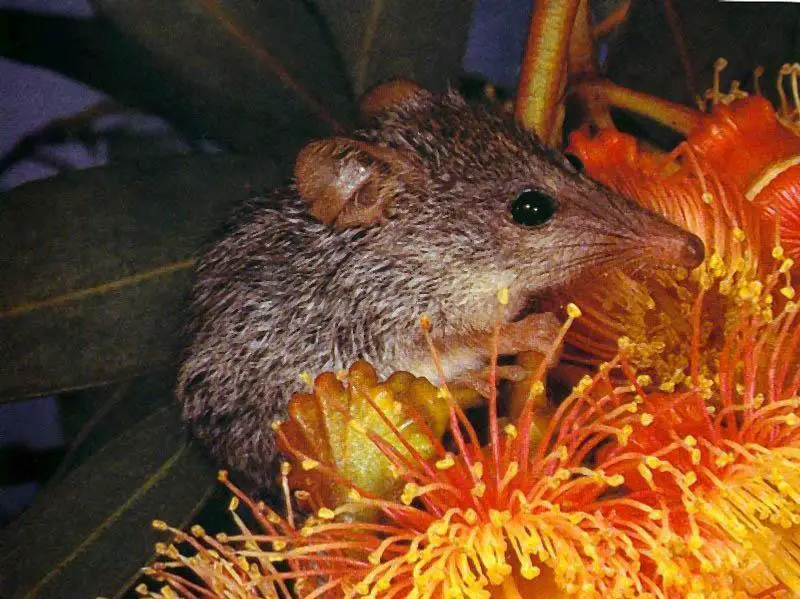
The honey possum (Tarsipes rostratus) is a species of marsupial found in Australia.  They are very small mammals and are also known as the noolbenger.


Physical Features
The honey possum is a tiny, mouse-like marsupial weighing 6 to 17 grams.  Males are smaller than females.  They measure about 10 cm while their tail is longer, measuring 11 cm.  Their fur is grayish-brown in color and is marked with three stripes along its back.  The honey possum has long fingers with rounded tips and very short nails.  Females have 4 teats in their well developed pouch.  Honey possums have long, prehensile tails with hooked tips.  They have long snouts


Diet                                                                                  Honey possum feeding
The honey possum is a herbivore, feeding on pollen grains and nectar with the help of their long snout.


Distribution and Habitat
The honey possum is mainly found in the south-western parts of Western Australia.  The live in trees and shrubs.


Behavior
The honey possum is active at night, making it a nocturnal.  They live in groups and often go torpid during cold weathers.  They are very agile on trees and are excellent climbers.  They do not make much noise unless mating.  Honey possums spend the day sleeping in hiding places between plants.


Life Cycle
Females give birth to about 2 young at any time of the year after a gestation period of 28 days.  It takes 2 months for the development of the young in the womb.  The young leaves the pouch of the mother at an age of 6 weeks at most.  The young is weaned at an age of 10 weeks.  Honey possums mature at the age of 10 months, having a life span of about 1 year.


Conservation Status
The honey possum is not considered to be threatened but is under the risk of habitat loss.  Their population is unknown.  Honey possums are very common.


Source of picture 1:http://board.muse.mu/showthread.php?t=20328&page=318
Source of picture 2:http://www.itsnature.org/trees/mammals-trees/honey-possum/