Monday, October 11, 2010

Brazilian tapir


The brazilian tapir (Tapirus terrestris) is also known as the South American tapir or the lowland tapir and is found in parts of South America.  It is one of the four species of tapir.  The other species of tapir are the Malayan tapir, the mountain tapir and the baird's tapir. 

Range
They are found in the east of the Andes and can be seen often near water in the Amazon rainforest and its river basin.  It is found in Venezuela, Brazil, Colombia, Ecuador, Peru, Bolivia, Paraguay, Argentina and the Guianas.

Physical features
The brazilian tapir can measure upto 8 feet with a shoulder height of 3 feet.  They can weigh a massive 270 kilograms and are termed as the largest land wild animal of South America.  Their body color is brown with a lighter brown on the face.  They have brown, round ears which have white outlines.  They have a bushy tail which is about 3 inches.

Behavior
The brazilian tapir loves swimming and diving.  Their natural predators in the water are the black caiman and the orinoco crocodile.  The brazilian can run in high speeds on land.  Their predators on land are the jaguar and the puma, the only land animals in the amazon which are capable of hunting prey this large.  Brazilian tapirs normally run away when the sense danger.

Diet
They are herbivores, using their mobile snout for eating different typesof plants.

Conservation status
The brazilian tapirs are endangered due to hunting as bushmeat and destruction of habitat.  Many people have started breeding programs to save this animal from extinction.

Source of picture 1:http://www.animalfactguide.com/animalfacts/brazilian-tapir/                                      

Sunday, October 10, 2010

Australian freshwater crocodile


The Australian freshwater crocodile (Crocodylus johnsoni) is also known as the Johnston's crocodile  and is found in northern Australia.  It is not known to attack humans as their prey is much smaller but no child should be left alone near this animal.  There have not been many reports of attacks or deaths.  It is much smaller than the saltwater crocodile.  It is locally called as the 'freshie.'  


Physical features                                               Snout of a freshwater crocodile
  Males measure about 9 feet and female grow up to 7 feet.  Their body color is light brown   and its body scales are big.  There were some specimens which were about 13 feet.  This species is very shy and is not aggressive like the saltwater crocodile.  It has a very slender snout and is a relatively small crocodilian.  It has round scales which cover the outsides and flanks of the legs.


Diet
The freshwater crocodile eats bats, amphibians, reptiles and fish.  It may even eat larger animals like wallaby.


Distribution and Habitat
They occur in Western Australia, Northern Territory and Queensland.  It prefers habitats like billabongs, creeks, wetlands and rivers.  They are not in the range of the saltwater crocodile.  Even though they live in freshwater habitats, they are tolerant to saltwater.
                                                                                                 
Conservation status                          A 'freshie' in Hartley's Crocodile farm at Cairns
The freshwater crocodile is not under much threat.  Only few numbers have decreased as it preys on the cane toad and dies due to the toxin secreted from the paratoid gland.


Source of picture 1:http://commons.wikimedia.org/wiki/File:Australia_Cairns_18.jpg
Source of picture 2:http://www.kangaruni.com/tips/crocs-be-prepared

Saturday, October 9, 2010

Blue Malaysian coral snake


The blue malaysian coral snake (Calliophis bivirgatus)  is an elapid found in Asia.  It was first identified in 1827.


Physical features                                        
It is a deep blue color with stripes which are light blue or white color.  It is very slender and measures about 5 feet even though there have been larger specimens caught.  They have small eyes at the sides of their blunt head.  The head, venter and tail are normally bright red.
Juveniles are often confused with pink headed reed snakes which are completely non venomous.


Behavior
The blue malaysian coral snake is nocturnal.  Most of the people get bitten during the night if they enter its territory.  Its behavior resembles that of a banded krait as it is very shy and inactive in the day.
As defense, it displays its bright red.  Sometimes they even hide their head by coiling up their body and they show their tail to confuse the predator 


Distribution
It is found in Malaysia, Singapore, Thailand, Cambodia and Indonesia.


Venom features
The venom of the blue malaysian coral snake is neurotoxic like most of the elapids.  Initially, there are no effects after a bite for several minutes.  After sometime, the victim will have numbness and then difficulty in breathing.  The victim finally dies due to respiratory failure.
It is sometimes called the "100 paces" as no man can walk more than 100 steps after getting bitten.

Source of picture 1http://www.sareptiles.co.za/forum/viewtopic.php?f=4&t=18727                             

Wednesday, October 6, 2010

Hoatzin


The hoatzin (Opisthocomus hoazin) is also known as the stinkbird, hoactzin or the canje pheasant.
It gets the name stinkbird because of the smell that comes from it due to daily consumption of leaves.  It is the only member of the genus Opisthocomus which means wearing  long hair behind in ancient Greek.  It is given this name as it has a crest on the back of its neck.


Physical Features                                                   Close up of a hoatzin's head

The hoatzin grows about 65 cm in length.   It has a face with no feathers and has maroon eyes.  On the top of its head there is a spiky crest which makes it different from other birds.  It has a small head and a long body.  It is a very noisy bird, having discordant noises like hissing, croaking, groaning and grunting.  They make these noises to contact with other individuals or groups and to warn off intruders. 

Diet
The hoatzin's staple food is leaves.  It also eats fruits and flowers from its marshy habitat occasionally.  When it  looks for food, it is often seen scrambling around awkwardly and being quite tame.  People once  thought that the hoatzin eats leaves only from mangroves and arums.  Later, zoologists found out that this bird consumes leaves from more than 50 species of trees.  It has a leathery bump on the bottom of its crop to keep balance while going from branch to branch to look for food.  After one experiment in Venezuela, the zoologists found out that an hoatzin's diet includes 82% leaves, 10% flowers and 8% fruits.

Breeding
Hoatzin's live in colonies.  They breed during the rainy season.  They lay 2 to 3 eggs in a nest, which is made on trees and some are made hanging above water in seasonal flooded forests.  The chicks have a very awkward feature: they are born with claws on their wings.  They have this feature to avoid predation.  When a predator arrives, the chick will fall inside the water.  They use the claws to to climb up the nest again. 

Distribution
The hoatzin is found in the amazon.  They are found in the amazon's mangrove forests too.  Their range included Venezuela, Peru and Brazil.

Source of picture 1:http://stinkyturkey.wordpress.com/
Source of picture 2:http://www.telegraph.co.uk/travel/destinations/southamerica/brazil/2558859/Brazilian-Amazon-logging-versus-eco-lodges.html 

Monday, October 4, 2010

Blood python


The blood python (python curtus) is a species of python and is non-venomous.  They are found in Southeast Asia.  There are three subspecies.


Physical Features
Adult blood pythons range from the size of 5 to 8 feet.  They have a pattern which is beige, tan or grayish brown ground color overlaid with blotches of brick red or blood red.  They are heavy built.  Their tail is extremely short in relation to its body.

Diet
The blood python feeds on many varieties of birds and mammals.

Common name
Short tailed python, blood python, short python, black blood python, Sumatran short tailed python and Sumatran blood python.

Distribution
Blood pythons are found in Thailand, Malaysia, Indonesia and Sumatra.

Habitat
They are found in rainforests where they live in marshes, swamps and long river banks and streams.


Source of picture 1:http://www.vpi.com/galleries/images/375


Sunday, October 3, 2010

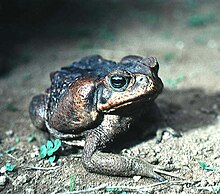
Cane toad


The cane toad (Bufo marinus) is also known as the marine toad or the giant neotropical toad.  It is native to Central and South America and has been introduced to Australia and the Caribbean islands.
They have poison glands and the tadpoles can be very dangerous if digested.  Since it has a devouring appetite, it has been introduced to Australia and the Caribbean for a method in agriculture to control pests.  The cane toad
gets its name from the cane beetle which it is used against.  Now, the cane toad itself is considered as a pest and many species of reptiles in Australia, like the monitors, are going to be classified as a threatened species as they eat this toad.  When they eat this toad, they die as the cane toad secrets poison from its glands.


Physical Features                                                                  Female cane toad                    
Cane toads are the largest toads, especially females, who are longer than males.  Females grow 10 to 15 inches long.  They live for about 15 years in the wild whereas in captivity, they are few specimens which survived till the age of 35.  The biggest cane toad is a pet in Sweden named Prinsen who weighs about 2 kg and measured 38 cm snout to vent.  When it is fully extended, it reaches a length of 54 cm.
Cane toads have warty and dry skin.  They have big paratoid glands under each eye.
Juvenile cane toads are much smaller than adult cane toads at 5 to 10 cm.  Some juveniles have a red wash while most of them have smooth dark skin.  They do not have fully developed paratoid glands and therefore are not as poisonous as adults.


Diet
Cane toads track down their prey using the sense of smell and vision.  They normally feed on invertebrates, birds, reptiles, rodents and other amphibians.  They also eat dog food if they are kept as a pet.  They eat their prey by swallowing it whole.


Defense                                                        Paratoid are below the eyes
The cane toad has paratoid glands below their eyes and across their back which secrete a toxin called bufotoxin.  When threatened, they will secrete this toxin which is like a milky white fluid.  Many animals die when they eat this toads and even some humans have died.
Cane toads are even capable of inflating their lungs, puff up and raise there body to look more taller and bigger when they face more dangerous predators.


Distribution
Cane toads are native to the Americas.  It was introduced to South America and Australia.  It lives in semi-arid areas and tropic environment.


Predators
The cane toads have many predators in its native range.  They are: the banded cat eyed snake, broad snouted caiman, eels, species of killfish, rock flagtail, some species of catfish and different species of ibis.  The predators outside its native range include the whistling kite, rakali, the black rat and monitors.

Source of picture 1: http://www.zimbio.com/pictures/oM3V0WcqZFd/Townsville+Hosts+Cane+Toad+Collection+Day
Source of picture 2:http://larrybiggs.net/scwf/index.php?mod=103&action=0&id=1195616778
Source of picture 3:http://en.wikipedia.org/wiki/Cane_toad

Saturday, October 2, 2010

King Cobra


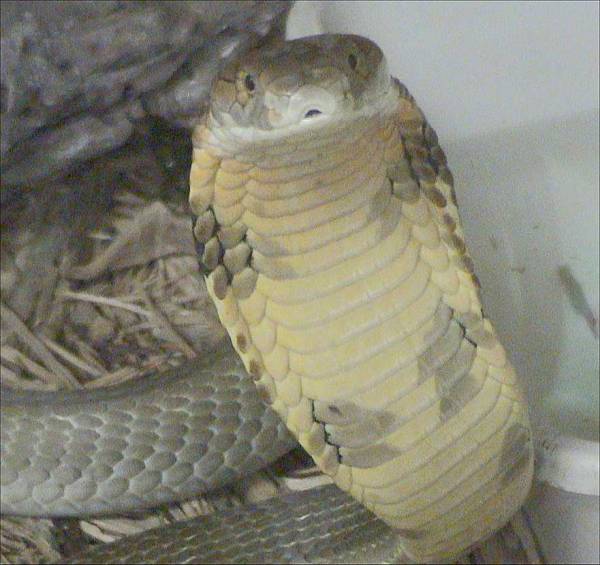
The king cobra(Ophiophagus hannah) is one of the most feared snake in all of south Asia.  It is the world's longest venomous snake and is a very fierce and agile hunter.  Its venom is very dangerous and it delivers a lot of venom in one bite.

Physical Features                                                
Full grown male king cobra
The king cobra is the longest venomous snake in the world.  It grows 18.8 feet long.  It can be tan, olive green or black in color.  A full grown king cobra can lift its head high enough to reach a man or a woman who is standing upright.  It has cross bands which  are a faint, pale yellow.  The scales of the belly are smoothed and the color of the belly is pale yellow or cream.  Juvenile king cobras have narrow yellow bands.  The body color is a shiny black for the juveniles. These juveniles are often mistaken for banded kraits, but immediately identified with its hood.  King cobras have an average lifespan of 20 years.  Males have about 250 ventral scales whereas females have about 265.  They have 15 rows of dorsal scales on the mid body.  On the tail, they have a single or a paired subcaudal scales in each row.  Males have 96 of these scales, whereas,  female have 98.
The king cobra is the sole species of the genus Ophiophagus and is not classified in the genus of  Naja, which makes it different from other species if cobras.

Distribution and Habitat
The king cobra is widespread throughout southern and south eastern Asia.  It is normally found in thick forests.  It likes to live near lakes and ponds.  Population has dropped mildly in very few places and is not considered as an endangered species of snake.

Diet                                                                
The name Ophiophagus means "snake eater".  It is given this name as it eats snakes, sometimes sizeable pythons, kraits, ratsnakes and other venomous snakes.  When food is not available it may even eat small invertebrates, rodents and small birds.  Sometimes, if the the prey is too big, the king cobra may even constrict its prey to death.  This sight is seen rarely.  After it eats a meal, it will not eat another for a month.

Venom
The king cobra injects neurotoxic venom which also contains cardiotoxic elements.  If bitten, the venom will go straight to the victim's central nervous system and causes paralysis, vertigo and severe pain.  During a bite, the venom is forced through the snake's  half inch fangs.

Reproduction
The female king cobra is a devoted parent.  Before laying her eggs, she uses her long body to gather up leaves and make a pile of them.  She then lays 20 to 40 eggs int he pile of leaves which acts like an incubator.
She guards the eggs and if a trespasser comes near the eggs, she displays an aggressive bustle to scare the trespasser away.
The eggs get incubated steadily with a temperature of  28°C.  After the eggs hatch, the mother is forced to leave in search of food so that she doesn't eat the young.  The hatchlings are about 22 inches when they hatch.

Defense
When threatened, the king cobra raises it's body, displays it's fangs and hisses loudly.  King cobras are very fast and can attack at a striking distance of 7 feet.  Many people misjudge the sake distance.  Even though, it is very venomous, it normally prefers to escape unless it is provoked or cornered.  The king cobra gives multiple bites or it bites and holds on.  When it encounters a natural predator, like a mongoose can resist venom, the king cobra will flee.  If it is not able to escape, it will expand its hood and release a loud hiss.  This is a good technique to escape from predators.

Photo 1 credited to Prajwal Mujumdar,picture 2