Wednesday, October 31, 2018

Short Beaked Echidna


The short beaked echidna (Tachyglossus aculeatus), also known as the short nosed spiny anteater, is a monotreme found in Australia as well as parts of New Guinea.  It is one of the three egg laying mammals, the others being the long beaked echidna and the platypus.

Physical Features
The short beaked echidna is a short legged animal covered with large yellowish spines over dark brown thick fur.  It has an elongated snout with a long tongue which enables it to scavenge for ants and other insects.  Its large spines protect it from predators while its strong and stocky limbs allow it to dig burrows quickly.  The short beaked echidna can grow to a length of anywhere between 30 cm and 50 cm and can easily weigh 5 kg.  These echidnas have shown many physical adaptation to various situations.  They can tolerate air with low levels of oxygen which allows them to live in burrows or survive forest fires.  They are also known to dive under water in case of floods.  During this period, they slow down their heart rate in order to provide maximum oxygen to the heart and brain.  Their body also allows them to undertake hibernation during winter periods during which their body temperature can fall to as low as 4°C .

Distribution and Habitat
Short beaked echidnas are found all over Australia and Tasmania.  It is also present in southern parts of New Guinea.  They inhabit forested areas, scrub regions and even rocky landscapes.  They are also seen in urban parks and gardens though not frequently.

Behavior
An echidna curling up into a ball to fend off a fox attack
Short beaked echidnas are nocturnal in summers but are otherwise active during they day.  They are generally solitary and interact with other individuals solely for the purpose of mating.  In certain parts of their range, echidnas hibernate during winters.  Females dig burrows for laying and rearing their young.  When attacked by predators, they curl themselves into a ball making them almost impenetrable due to their spines.  Short beaked echidnas mainly feed on ants and termites although they may feed on other insects.

Conservation Status
Short beaked echidnas are abundant in most of its range.  The main threats they face are habitat destruction and motor vehicle accidents.  Many invasive species such as cats and foxes prey upon short beaked echidnas.  They are rated as 'Least Concern' by the IUCN.

Saturday, September 30, 2017

Northern Plains Langur


The Northern Plains Langur (Semnopithecus entellus) is a species of grey langur found mainly in the central portions of India.  It is one of the most widespread langur species of India and is frequently found living in human settlements.  It is one of the eight grey langur species found in India.

Physical Features
The forward bending tail of a Northern Plains Langur
Northern Plains Langurs can range from greyish-brown to yellowish-brown in colour.  Its ventral side may be buff or pale orange while the face is black in colour.  It lacks a mane unlike the langurs found further north.  The hands of a Northern Plains Langur are very long as an arboreal adaptation and are black till the wrists.  Its fingers are long and slender enabling them to grip on to branches.  The body length of Northern Plains Langurs (excluding the tail) is around 2-2.5 feet for males while females are around 1.5-2 feet long.  It has a forward bending tail like all the grey langur species found in the north which distinguishes it from the southern species of grey langurs, which have backward bending tails.  Their prehensile tails can reach lengths of 3 feet.  Males and females weigh around 10 kilograms.


Distribution and Habitat
Northern Plains Langurs are common in human settlements
The Northern Plains Langur is the most widespread and populous species of grey langur in India.  It is found in the states of Madhya Pradesh, Bihar, parts of Rajasthan, Gujarat, West Bengal, Chhattisgarh, Orissa and Maharashtra.  It has been introduced in parts of Bangladesh.  It ranges from the Godavari river in central India to river Krishna in the south east and river Narmada in the south west.  It is found in a wide variety of habitat; from deciduous forests to scrub land.  It has become very common in human settlements and large populations can be found in various towns.  Some cities like Jodhpur, Rajasthan have populations of several thousand.

Behavior and Reproduction
Langurs grooming each other
The Northern Plains Langur is a social animal and lives in groups that can have up to 100 individuals.  In a group, there may only be a few resident males.Only male groups are also common though they are smaller in size.  Females carry out activities like foraging and grooming.  The females generally groom the males and care for their babies.  Males leave the group once they attain adulthood.  Northern Plains Langurs are diurnal animals and generally prefer high branches while sleeping at night although they have adapted to sleeping on man-made structures.  Females have a gestation period of around 200 days and generally give birth to a single infant.  The infants usually remain attached to the mothers' chest spending most of their time suckling or sleeping for the first two weeks.  Females may also take care of infants that are not theirs.  Infanticide by the males are common especially in groups which are head by a single male.  

Diet
Northern Plains Langurs are mainly herbivores.  They feed on fruits, roots, shoots, bamboos, leaves and shrubs.  They have also adapted to human food and a often fed by people.  Agricultural lands are frequently invaded by these langurs for feeding purposes.

Conservation and Threats
Northern Plains Langurs are rated as Least Concern by the IUCN, indicating that they are not at the risk of extinction.  Indian laws prohibit killing of these langurs.  They are considered sacred by Hindus and are looked upon as 'Hanuman', the monkey god in Hindu mythology.  Since they are not as notorious as the rhesus macaque, they are not considered as pests.  Many langurs are killed every year due to road accidents.  They are also threatened with habitat destruction, forest fires and mining.  Habitat fragmentation has caused them to find shelter in human settlements.

Wednesday, November 2, 2016

Lion Tailed Macaque


The lion tailed macaque (Macaca silenus) is a species of monkey that is exclusively found in the southern region of India.  It is rated as 'Endangered' by the IUCN.

Physical Features
The lion tailed macaque is a medium sized monkey that ranges from lengths of 35 cm to 60 cm.  Males are slightly larger than females.  It has black hair throughout its body except the face region.  The face is black and hairless.  The unique and distinct feature of the lion tailed macaque is its mane.  Its silver white mane distinguishes it from the otherwise similar Nilgiri Langur.  

Distribution and Habitat
A lion tailed macaque
The lion tailed macaque is restricted to the evergreen forests of the Western Ghats range in southern India.  Majority of the population is present in Kerala, India.  Other populations are present in the Anamalai hills of Tamil Nadu and the Western Ghats section of Karnataka. The Silent Valley National Park is a famous stronghold of the lion tailed macaque.  Lion tailed macaques live in evergreen forests that can be 1700 m above mean sea level.  They require isolated environments which is one of the key reasons for a decline in their numbers. The estimated population is said to be about 4000 individuals.  Habitat encroachment and destruction is the main threat to the population.

Behaviour
The lion tailed macaque is a social animal and live in groups that may consist of 10 to 60 individuals.  Lesser the region is disturbed by humans, smaller the group size.  They are mainly arboreal and spend most of their time in the upper canopy of evergreen forests. Unlike other macaques like the rhesus macaque, the avoid humans.  Their cries have a uncanny resemblance to that of humans.  They may become aggressive in case of territorial disputes.

Diet
Lion tailed macaques mainly eat fruits, shoots, leaves, insects or even small vertebrates. They feed on the indigenous plants and trees of their area but may adapt in areas where logging is excessive.  Eggs of various birds also constitute their diet.

Conservation Status
The lion tailed macaque is rated as 'Endangered' by the IUCN.  Their population has faced considerable decline due to habitat destruction for agricultural purposes and habitat encroachment by humans.  Unlike other macaques, they avoid humans and hence do not reside in agricultural lands.  They were once rated as one of the most endangered primates in the world but now, thanks to severe measures taken by the Indian government to protect this species, they are off that list. 

Saturday, April 23, 2016

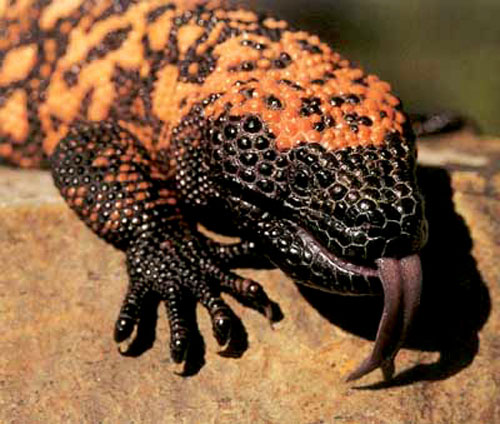
Gila Monster


The Gila Monster (Heloderma suspectum) is a species of lizard found in North America.  It is one of the very few venomous lizards in the world.  

Physical Features
The Gila monster is a stout lizards and can reach lengths of 2 feet.  They have a rounded head and their body has patches of orange, yellow and black which helps it camouflage in the desert environment.  They have powerful limbs with long claws while their tail is fat and short.  They can weigh anywhere between 300 grams to 700 grams while the largest specimen reported was 2.3 kilograms.

Venom
The Gila Monster is one of the two venomous lizards of North America, the other one being the Beaded lizard.  The Gila monster's venom is a neurotoxin and is said to be as toxic as a coral snake's venom.  However a bite delivered from the Gila Monster to an adult, healthy human is not fatal as it produces the venom in very minute quantities.  There are no reported cases of human deaths from Gila monster bites.  The venom of a Gila monster is found to have proteins which are effective in the treatment of type-2 diabetes. 

Distribution and Habitat
The Gila Monster is confined to the south western parts of the United Sates of America and the north western parts of Mexico.  They inhabit dry grasslands, foothills of mountains and succulent desert. 

Diet
The Gila monster mainly feeds on the eggs of birds and reptiles.  They also feed on insects and small mammals.

Behavior
The Gila monster Changes its time of activity depending upon the season and temperatures.  It spends most of its time burrowing.  It is generally sluggish and shy which is why there are not many cases of Gila monster bites. 

Conservation Status
The Gila monster is rated as 'Near Threatened' by the IUCN.  It has suffered a population decline over the past couple of decades.  It faces threats from habitat destruction and illegal pet trading.  Large parts of their habitat has disappeared due to urbanization and agriculture.

Pic 1

Thursday, April 14, 2016

Malabar Giant Squirrel


The Malabar giant squirrel (Ratufa indica) is a large species of squirrel native to India.  It is one of the largest species of squirrels in the world.

Physical Features
The malabar giant squirrels have a black or maroon back with its ventral side, face and tail being cream or buff.  Its body length can be anywhere between 30cm-50cm while its tail is around 2 feet long.  

Behavior
The malabar giant squirrel is generally active in the evening as well as in the early hours of the morning.  They spend most of their time on trees and are seldom seen on the forest floor.  When threatened they freeze or lie flat against a tree.  They are very shy animals. They are generally solitary except during breeding season.

Diet
The malabar giant squirrel primarily feeds on fruits, making it a herbivore.

Distribution and Habitat
Malabar giant squirrels generally inhabit mixed deciduous forests and moist evergreen forests with high canopies.  A large portion of their population is present in the forests of Peninsular India, in the states of Kerala, Karnataka, Maharashtra and parts of Madhya Pradesh.

Conservation Status
The malabar giant squirrel is rated as 'Least Concern' by the IUCN.  However, its population is threatened by illegal pet trade, habitat destruction and hunting.  It is a protected species and is the state animal of the Indian state, Maharashtra.  

Tuesday, March 22, 2016

Snow Leopard


The snow leopard (Panthera uncia) is a large cat species inhabiting the Himalayas.  It is rated as "Endangered" by the IUCN.

Taxonomy
For longtime, the classification of the snow leopard was a dispute.  In the past it was placed under its own genus Uncia.  Many scientists were against that and thought that it should be placed under the the genus of Panthera, which contained the big cats (tiger, lion, leopard and jaguar).  However, a scientist named Pocock (he described the genus Panthera) said that the snow leopard has certain morphological differences and hence cannot be placed in the genus of Panthera.  However, in 2008, through genotyping, it was proved that the snow leopard in fact does belong to the Panthera genus.  As a result, its scientific name was changed from Uncia uncia to Panthera uncia.

Physical Features
The snow leopard is relatively smaller when compared to other members of the Panthera genus.  Their body (including head) length can range from 80 cm to 130 cm.  Their tails can grow up to lengths of 100 cm.  Adult snow leopards generally weigh anywhere between 30 kg-55 kg.  However, there are records of males weighing 75 kg.  Snow leopards have a coat perfectly adapted for cold regions.  It has thick fur which can range from a smoky grey to a creamy white and has dark rosettes all over its body except for the ventral portion.  This combination allows it a perfect camouflage.  Each individual rosette differs from another.  The fur on the belly of the snow leopard can be about 10 cm long which helps keep itself warm and live in areas where the temperatures can sink below -40 degrees Celsius.  The snow leopard has an enlarged nasal cavity which warms the air it breaths and allows it to inhale the thin air of high altitudes.  It has relatively larger paws which allows it to easily walk on snow and its long, thick tail provides it balance in rocky terrain.  It also uses its tail as a blanket while sleeping.  Due to its imperfectly ossified hyoid bone, it cant roar like its Panthera counterparts but can growl and snarl.

Distribution and Habitat
Snow leopards live in mountainous terrains.  A large percent of the snow leopard population is confined to the Himalayan range.  They inhabit mountainside grasslands as well as lightly forested areas at altitudes between 2,300-6,000 meters high.  Their range includes the northern parts of India, Nepal, Himalayan border of China, Russia, Tajikistan and Kazakhstan.

Diet 
Due to the harsh climatic conditions, snow leopards are forced to have a wide dietary range. The snow leopards feed on any mountains animals like goats, deer, pikas and marmots. Domestic animals also constitute their diet.  They also hunt down large prey such as Ibex.

Conservation Status
The snow leopard is rated as 'Endangered' by the IUCN.  It has been subjected to poaching, habitat loss and prey loss.  Most of the population has been wiped out from Russia due to poaching for their fur.  The current population is estimated to be about 6000 individuals.  It is a highly protected species and its hunting has been banned in most of the countries.  It is the national animal of Afghanistan and the National Heritage animal of Pakistan.

Pic 1

Friday, September 18, 2015

Russell's Viper


Russel's viper (Daboia russelli) is a large species of viper found throughout the Indian subcontinent and other parts of south-east Asia.  Most of the snakebites (about 50%) in the Indian subcontinent are caused by the Russell's viper.

Physical Features
The russell's viper is a large and bulky viper, normally growing about 1 to 1.2 meters long.  However, specimens over 1.5 m have been recorded.  The color of their dorsal side is generally brown of varying shades, tan or deep yellow.  Their are a series of dark ovals running along their back which are outlined successively by black and white.  Another series of similar ovals runs down each flank alternating with those on the back.  They have a triangular head with a blunt snout.  Their head is very distinct from the body and they have very short tails.  Their belly is white, yellowish or sometimes pinkish.  The coat of the russell's viper very closely resembles that of the rough scaled boa, a harmless snake.

Distribution and Habitat
The russell's viper is widespread in the Indian subcontinent and is also found in Thailand and the Indo-Australian archipelago.  It is most common in India, Sri Lanka, Pakistan and Myanmar.  It inhabits plains, grasslands and plantations.  However, it has been recorded at heights of 2,100 m in south India and 2,000 m in the Himalayas.  It is common along the west coast of India.  It is abundant in Punjab but quite rare in the Ganga Valley.

Diet
Their diet mainly consists of rodents like mice, rats, squirrels, etc.  However, they will eat anything like lizards, frogs and small birds.  Juveniles are known to be cannibalistic.

Behavior
The russell's viper is largely nocturnal.  Adults are known to be sluggish while juveniles are more excited and alert.  When aggravated, they stand their ground and produce a loud hiss that is distinctly louder than other snakes.  They are slow movers.  However, when they strike, they hurtle themselves with such force that they may even leave the ground.  Adults normally just prefer to just hiss when disturbed while juveniles may be more aggressive and bite.

Reproduction Cycle
Russell's vipers are ovoviviparous.  This is a mode of reproduction where the embryo's develop inside eggs which remains in the mother's stomach till they are ready to hatch.  The embryo's are nourished by the egg yolk. After they hatch, the mother gives birth to them.  A russell's viper generally gives birth to litters of 20 to 40 young.  However they have been known to give birth to litters of 63 individual as well as to a single young.  The gestation period exceeds six months.  Gravid females have been recorded in all months of the year. Females give birth between the months of May and November.  They sexually mature at the age of 2-3 years. 

Venom
A dose of 50-70 mg is lethal to an adult human.  The bite results in immediate pain and swelling in that region.  Post 20 minutes, bleeding occurs in the gums, urine and sometimes sputum.  Necrosis (the premature death of cells due to injuries) is a common symptoms.  Heart rate falls and blood pressure drops.  The victim may die of kidney failure, septicemia or cardiac arrest.  Death from any of these may occur in a period of 1 to 10 days.  Russell's viper used to cause about 300,000 deaths per year in the Indian Subcontinent before the introduction of its antivenin.  This has reduced the deaths by russell's viper considerably. 

Saturday, January 24, 2015

Cotton-top Tamarin


The cotton-top tamarin (Saguinus oedipus) is a small species of primate found only in a small part of South America.  It is rated as "Critically Endangered" by the IUCN.  It is a popular exhibit in zoos all around the world.

Physical Features
The cotton-top tamarin is an unmistakable species.  It gets its name from the elegant, long, white flowing fur on its head.  They generally weigh only about 420-450 grams. Their body length can be about 20-25 cm long while their tail can be about 35-40 cm long. Their tail is not prehensile i.e. it has not adapted to hold or manipulate objects. Males and females are generally same in size.  Their face is generally black or gray in color with very fine white hair which is barely visible.  Their back (dorsal side) is covered with brown fur while their front (ventral side) is covered with white or yellowish white fur.  Their tail is also covered in brown fur.  Unlike other monkeys, the cotton-top tamarin's thumbs are not opposable.

Diet
Cotton top tamarin feeding on some dry fruits.
Cotton-top tamarins are omnivorous.  They equally depend on plant material and animal material.  They consume organisms that are smaller than them like small lizards, amphibians and insects. Insects are a main constituents of their diet.  Plant material consists of fruits, flowers, nectar, seeds and plant sap.  They require very nutritious and high energy foods due to their small size and high food intake.  

Distribution and Habitat
The range of cotton-top tamarins are limited to the north-western side of Colombia, between the rivers Atrato,  Cauca and Magdalena.  Even in this region, their habitat is fragmented. They live in both tropical humid forests as well as tropical deciduous forests, primary as well as secondary forests.  They prefer to live in the lower levels of forests but may descend to the ground in search of food or ascend tall trees for protection or food.  They sleep in foliage cover.

Behavior
Cotton-top tamarins are diurnal.  They either live in pairs but more often live in groups. They spend the days foraging and grooming.  They are very social animals and each group may consist 5-15 members.  They follow a matriarchal system i.e. the leader of a group is the eldest female.  Cotton-top tamarins groups follow a "helper" system where males and older siblings take care of the young and newly born for sometime.

Life Cycle and Breeding
Infants along with parent.
In a group of 10-15 individuals normally only one male-female pairs breed.  It is very often for twins to be born.  The breeding season is between the months of April and July.  A female cotton-top tamarin gives birth to a single offspring or twins after a gestation period of 4-5 months.  Males take care and groom the infants more than the female.  Cotton-top tamarins are known to live in captivity for 20 years while in wild, they often live for about 13 to 14 years.

Conservation Status   
The cotton-top tamarin is rated as "Critically Endangered" by the IUCN.  There are approximately 6,000 individuals remaining.  Illegal pet trade and habitat fragmentation is the main cause of population decline.  It is said that between the 1960's and 1970's about 30,000 individuals were exported to the United Sates for bio-medical research.  The population is decreasing.  It was one of the most endangered species of primate in the world between 2008-2011.  It is protected by the law.  The Paramillo National Park is one of the most important stretch of forest for this species and comprises of 1800 square miles.  There are enough number of individuals in captivity for the sustenance of this species.  It is said that their are more captive individuals than wild ones.

Source of pic 2, pic 3 

Friday, January 23, 2015

Bengal Monitor


The Bengal monitor (Varanus bengalensis) is a common, medium sized monitor lizard found in the Indian Subcontinent.  It is rated as " Least Concern" by the IUCN but its population is decreasing due to habitat fragmentation and hunting.

Physical Features
Brightly colored juvenile
The length of a bengal monitor can range from 1 meter to 1.8 meters. Males are larger than females. These monitors can weigh up to 7 kilograms.  Its head is relatively small as compared to the body but its snout is more rounded than the water monitor, which is a main distinction other than the size.  It has a thick and stocky head and short limbs. Adults' dorsal side can be olive, gray, black or brownish in color with sparse black spots. The ventral side is generally yellowish. Juveniles are brightly colored with series of dark bars on the neck and back which are sometimes accompanied by spots.  Bengal monitors have external nostril openings known as nares which they can close on will to prevent the entering of water or any other particulate matter.

Distribution and Habitat
The bengal monitor is the most common monitor in the Indian Subcontinent.   They are also found in Iran, Malysia, Java and Sumatra.  They are absent in the Andaman Islands. They can be found in rainforests, swamps and arid regions.  They are often found in agricultural and cultivated land.  They can be found in burrows, tree hollows and termite mounds.

Diet
They eat insects, small mammals, amphibians and other lizards.  It basically eats anything it can overpower.  They may even scale trees to stalk bats.  Juveniles are almost completely insectivorous.  It is a common sight to see them stealing eggs from nests, be it a bird's or crocodile's.  It senses its prey by both smell and sight.

Habits and Behavior
Bengal monitors are diurnal creatures.  They often dwell in trees or burrows.  Just like snakes, they flick their tongues out to "taste the air".  They can run at high speeds and are very able climbers.  They are also good swimmers.  They are generally very docile creatures.  When alarmed or threatened, it tries lies still to remain unseen or escape notice. When cornered, it may even stand on forelegs and lash its tail repeatedly on the ground. Bites from these monitors are quite painful and once the jaw is embedded into the flesh, it is difficult to remove due to its curved teeth.  They lead a solitary life and have a keen eyesight.

Life Cycle and Breeding
Bengal monitor in Bannerghatta National Park, Karnataka, India.
Bengal monitors are known to survive for 20 years in captivity, though it is generally lesser in the wild.  Males become territorial during the mating season (which they are generally not). Males battles each other for mates by standing up on their hindlegs. Sounds made during the mating season are generally restricted to hissing though bellowing has been recorded.  About 1 to 3 clutches of eggs are laid by the females with each containing about 20-30 eggs.  The female digs a pit to place the eggs and covers it with soil.  She may build a few false pits around it to mislead predators.  The eggs hatch after and incubation period of 6-9 months.

Conservation Status
The bengal monitor is rated as "Least Concern" by the IUCN.  It is the most widespread monitor in the Indian subcontinent, which consists of most of its range.  Its population is decreasing in certain parts of its range due to hunting for skin.  Illegal pet trade is also a contributing factor.  It is now a protected species by many governments. 

Source of pic 2    

Saturday, September 6, 2014

Gaboon Viper


The gaboon viper (Bitis gabonica) is a species of viper found in Africa.  It is renowned for its long fangs.  It is quite common in its range.

Physical Features
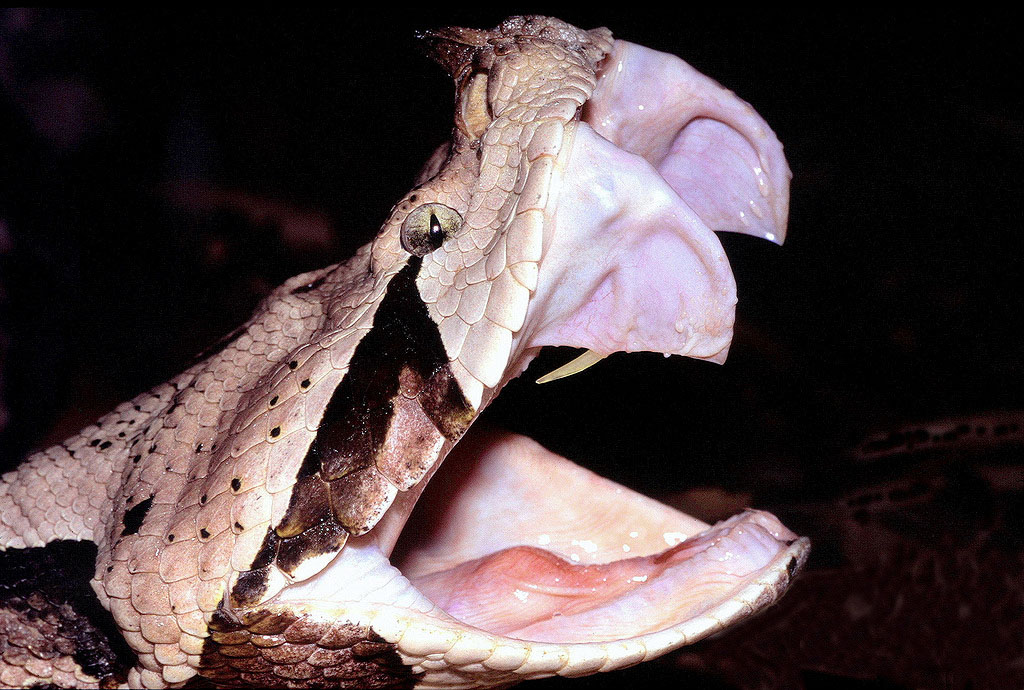
The gaboon viper is the world's largest viperid, weighing about 8 kilograms.  It has the longest fangs of any snake, which can measure up to 5 cm.  It is the longest African viper, ranging from lengths of 1 to 2 meters(3 to 6.6 feet).  The gaboon viper has a flat, triangular head with two small, hornlike structures on its snout.  It has a stout body with distinguishing geometric shapes like triangles, diamonds and rectangles.  It has brownish skin with buffs of purple and pink.  Its head is thick due to the large venom glands present behind its eyes.  Its coloration allows it to blend with dried leaves which helps it ambush its prey.

Diet
The diet of a gaboon viper mainly consists of small mammals and birds.  It can even consume full grown rabbits, porcupines and monkeys.  There are even reports of it eating royal antelopes. 

Habitat and Distribution
The gaboon viper lives in tropical forests and open woodlands.  It lives on the forest floor where it camouflages among the leaf litters.  The gaboon viper is only present in Africa.  It is mainly in central, eastern and south eastern Africa with few isolated population in western Africa.  Some countries in its range are Kenya, Uganda, Nigeria, Sierra Leone, Togo, Guinea, Mozambique, Ghana and Zimbabwe.

Behavior and Venom
The fangs of a gaboon viper.
Gaboon vipers are considered to be very sluggish and slow moving but they strike with alarming speed.  It ambushes its prey by camouflaging with the surrounding.  It is a very tolerant snake and only bites when severely provoked.  When threatened, it gives a low, deep hiss.  Their venom is not very toxic but it is delivered in large amounts; the most by any snake.  It stores large amounts of venom in glands behind its eyes.  Gaboon vipers rarely display anger even when handled.  They are nocturnal and live on forest floors.

Life Cycle
Gaboon vipers are ovoviviparous (when the embryo develops in an egg and hatches inside the female itself) and give birth to litters of 60 young every 2 to 3 years.  They have gestation periods of 3 to 4 months.

Conservation Status
Gaboon vipers are very common in their range.   

Source of pic 1, pic 2       

Tuesday, April 29, 2014

Koala


The koala (Phascolarctos cinereus) is perhaps one of the most popular of the marsupials other than the kangaroo.  It is endemic to Australia.  It is rated as 'Near Threatened' by the IUCN and was previously hunted in large numbers for its fur.

Physical Features
The koala is a small marsupial that measures about 2 to 3 feet in length.  They have a very small tail that measures about 2 cm.  Males are larger than females.  Their weight ranges from 5 kg to 15 kg.  The koala is stockily built with teddy bear like features with woolly grayish brown fur and fluffy ears.  The fur on the ventral side is paler.  Koalas have one of the most insulating fur (dorsal side) of any marsupial while the ventral fur reflects solar radiation.  Males have more curved noses than females.  Koalas have short, powerful limbs with sharp claws that enable it to climb and cling on to eucalyptus trees on which it spends most of its life.  Koalas in the southern regions are found to be 50% larger than those in the north.  Koalas have the smallest brain in proportion to body weight of any animal.
A koala feeding.

Diet
Koalas are herbivorous.  The main constituent of their diet is eucalyptus leaves.  They may be found eating leaves from Acacia and Leptospermum.  They eat for about 4 hours in the night eating and may eat about 500 grams of leaves.  They eat leaves from about 30 species of eucalyptus trees out of the 600 species present.  They show more preference toward eucalyptus leaves with higher protein and lignin (polymer that is present in cell walls of plant cells).  They may descend to the ground for eating soil and gravel that helps in digestion.  The droppings of the mother is one of the first solid food eaten by young koalas as it carries disease fighting microbes.

Distribution and Habitat
Koalas are found in eastern Australia and inhabit eucalyptus forests.  They spend most of their time on eucalyptus trees.

Breeding
A koala sleeping
After a gestation period of 25 to 35 days, a single young is born during summer.  Twins are occasionally born.  They are suckled for 6 months in the mother's pouch.  After that period, they cling onto the mother's back.  

Behavior
Koalas are considered as one of the most laziest animals.  They are nocturnal and spend 4 hours in the night for feeding.  For the remaining 20 hours, they sleep.  They are arboreal and occasionally come to the ground either for eating soil or for crossing open spaces.  They normally lead a solitary life.

Conservation Status
The koalas are rated as 'Near Threatened' by the IUCN.  Koalas have few natural predators other than large birds of prey.  Sometimes, while crossing land, feral dogs attack and kill it.  A bacteria known as Chlamydia has caused a disease that affects koalas.  In the early 20th century, koalas were extensively killed for their fur.  Koalas are also affected by habitat destruction.  Now their numbers are slowly increasing due to the efforts of conservationists.  

Saturday, March 29, 2014

Transparent Animals


It is a little hard to believe that their are some animals in this world which are transparent. This transparency is caused either by the lack of pigmentation in a particular part of the body.  Here is a list of some of them:


Barreleye Fish

The barreleye fish (Macropinna microstoma) is a fish from the barreleye family.  Found at depths of about 700 meters, it is known for its transparent head.  It was first found in 1939 but the transparent head was not known as when it comes out of water, the head loses its transparency.  Its head is filled with a transparent liquid.  The two dots above the nose is often mistaken for eyes.  It is actually its nose.  The two spherical structures in the head is the eyes. The eyes are capable of rotating 360˚. It was first photographed with the transparent head in 2004.


Glass Frog

Glass frogs form the family Centrolenidae.  They are found in the Amazon rainforests.  Most of their body is green, except for the ventral part which is translucent, allowing you the see the heart, liver and the gastrointestinal tract.  They can reach lengths of 7 cm and are known to eat their own young.  Some species of frogs from this family have such a delicate skin that they can get killed even if a raindrop fall on their body from the sky.


Crocodile Icefish

Crocodile icefish (also known as white blooded fish) form the family of Channichthyidae, a family of perciform fish.  They are found in the Antarctic ocean.  They are transparent due to their blood which lacks the red pigment known as hemoglobin.  Hemoglobin is used to transport oxygen through the blood.  It is one of the only known vertebrates which lack hemoglobin.  It lives in waters which are about -1.9°C, which is the freezing point of seawater.  Due to the higher concentration of oxygen in such cold waters, it is able to survive.


Golden Tortoise Beetle

The golden tortoise beetle (Charidotella sexpunctata) is a species of beetle.  Its color ranges from gold to orange, earning it a name of 'goldbug'.  Its external margins are transparent due to the lack of pigmentation.  It changes color seasonally and also changes color when threatened.


Blue-bellied night wanderer


The blue bellied night wanderer (Cyanogaster noctivaga) is a species of fish found in the Amazon river.  It is known for its bright blue belly.  Most of its body is transparent, revealing its vertebral column.  It was discovered in 2011.  It immediately dies and loses its color after being removed from the water, making it difficult to examine.  It is mostly active in the night.


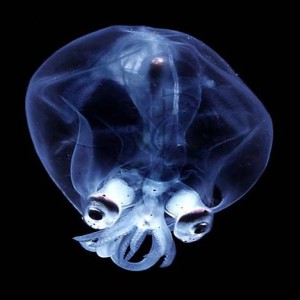
Glass Squid

The glass squids form the family Cranchiidae.  Their bodies are transparent.  Juveniles live in shallow waters as their transparency camouflages them when light passes through.  Adults descend to deeper waters and can be found at depths of 2 km below sea level.

Many jellyfish are also transparent like the moon jelly.

Source of pic 1, pic 2, pic 3, pic 5, pic 6.
Picture 4 was taken by Nita, a follower of this blog.

Wednesday, December 25, 2013

Common Hippopotamus


The common hippopotamus (Hippopotamus amphibus) is a species of even toed hoofed mammals endemic to Africa.  Though it is classified as a even toed hoofed mammal, it is thought to be more closely related to whales.  They are rated as 'Vulnerable' by the IUCN.

Physical Features
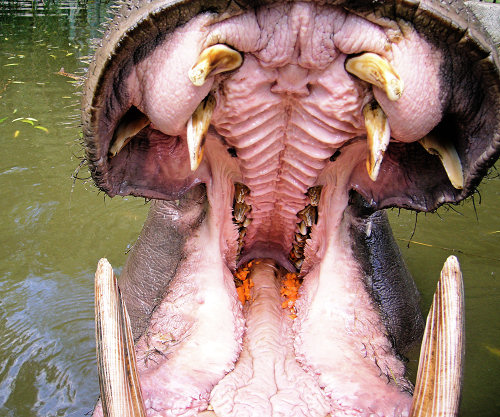
The hippopotamus is the third largest land animal by weight.  Males can weigh anywhere between 1.4 to 3 tonnes with females being smaller.  The largest hippopotamus was a male that weighed 4500 kilograms(4.5 tonnes).  Their bone density is slightly greater than that of water.  This allows it to gently sink in water.  However, if it inflates its lungs while on the surface of the water, it can remain afloat without much effort.  Hippopotamuses can grow about 9 to 15 feet long and have tails that can grow up to 1.5 feet.  Despite being so bulky, they can swim and walk underwater.  They can reach speeds of about 30 km/hr on land using their short, insubstantial looking legs.  Hippopotamuses feature very large jaws and can open their mouths at angle of 150 degrees.  Their body varies from a gray to blue-black upper body.  The lower part of their body has a slight pinkish tinge.  They have an expanded muzzle with the nose
The large canines and incisors of a hippopotamus
covered with sensitive bristles.  The hippopotamus has two layers of skin.  The first layer, known as the epidermis, is very sensitive and dries out fast.  The inner layer is extremely thick (about 3.5 cm thick).  Their eyes, ears and nostrils are all located on the top of the head as that is the part that mostly remains above water during their swim.  Other adaptations include webbed toes and nostrils with the ability to close.  Hippos can remain submerged underwater for over 5 minutes. Hippopotamuses are also known for their wide mouth.  They have incisors that can reach lengths of a foot and canines that can reach length of 1.5 feet.


Diet
The hippopotamus is mainly herbivorous, though some have been observed eating small animals.  The main constituent of its diet is savanna grass.  They generally graze at nights and are led to their food by a dung trail left by them.  They also eat commercial crops like rice present in agricultural regions.  A hippopotamus may eat about 40 kilograms of grass every day.  

Distribution and Habitat 
The hippopotamus is found in western, central, southern and eastern parts of Africa.  They generally inhabit short grasslands, muddy wallows, rivers and lakes.

Habits
The hippopotamus is mainly nocturnal.  It rests in water during day time and grazes during nights.  They make noises like squeals, bellows and rumbles.  They sometimes make noises characterized with a loud 'ho-ho-ho'.

Life Cycle
Females generally give birth to one calf in water after a gestation period of about 240 days. Females mature between the ages of seven and fifteen while males mature at the ages of six to 13.  Hippopotamuses can live for about 48 years in captivity.  In wild, they can live for about 45 years.  

Source of pic 1 and pic 2

Wednesday, October 2, 2013

Recently Discovered Animals

The world is always happening.  As we speak, unknown species may become extinct or discovered.  Here is a list of recently discovered animals.


The Olinguito


The olinguito (Bassaricyon neblina) is a species of carnivore discovered on 15th August,2013. It is the first carnivore in the western hemisphere to have been discovered in the last three decades. It was found in the mountane forests of the Andes of western Columbia and Ecuador. The olinguito was discovered Kristofer Helgen. The olinguito resembles a teddy bear. They weigh only about 0.5 to 1 kilograms, making them the smallest member of the raccoon family. Though they feed primarily on fruits and plants, they are part of the taxonomic order Carnivora. They are mainly nocturnal, making it difficult to spot and they have brown-orange fur.

The Yeti Crab

The yeti crab is placed under its own family known as Kiwa. There are two species that have been described: Kiwa Hirsuta and Kiwa Puravida. These species were discovered in 2005 and 2006 respectively. Kiwa Hirsuta was discovered along the Pacific-Antarctic Ridge about 1500 kilometers south of Easter Islands by a group set up by Robert Vrijenhoek. Kiwa Puravida was discovered in 2006 and described in 2011. It was found in a deep sea bottom off the coast of Costa Rica by Andrew Thurber, Kareen Schnabel and William J. Jones. For more details about this animal click here. This contains information about Kiwa Hirsuta.


The Boki Mekot Rat
An illustration of the new spiny rat species. Illustration courtesy Jon Fjeldsaa

The Boki Mekot rat (Halmaheramys bokimekot) is a species of rat that was discovered in the mountain forests of Halmahera, Indonesia. It is the newest member of the rodent family and was discovered by a group of researchers lead by Pierre-Henri Fabre. This rat has spiny brown fur and a stubby, white tipped tail. It was discovered in 2013 and also involved Kristofer Helgen, who had discovered the olinguito.

The Cambodian Tailor Bird

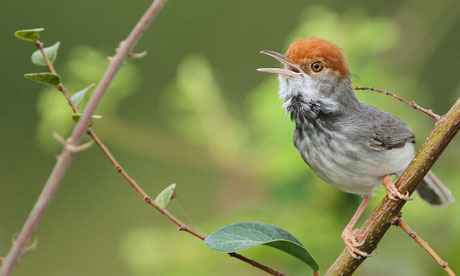
The Cambodian tailorbird (Orthotomus chaktomuk) is a species of bird first discovered in the busy city of Phnom Pehn, Cambodia. Despite living among the 1.5 million residents of this city, it was discovered only on 25th June, 2013. This bird has a black feathered throat and gray or olive colored wings. It has an unmistakable red or orange cap. It is found in the lowland scrubs of the city and is abundant in construction sites. It was not thought to be a new species until scientific analysis proved it to be distinct.


A. stebbinsi


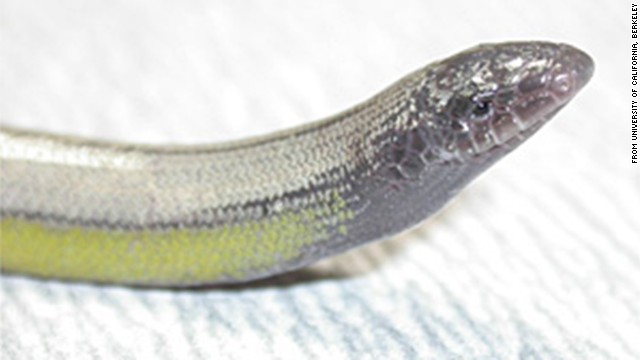
A.stebbinsi is a species of legless lizard that was discovered at the end of the airport runway of the Los Angeles International Airport. They were named after the famous herpetologist Robert C.Stebbins. They are yellow bellied legless lizards. They are found towards the west of the aiport. They were discovered in the year 2013.


Louisiana Pancake Batfish


The Louisiana Pancake batfish (Halieutichthys intermedius) is a species of fish discovered in the year 2010 under the Deepwater Horizon oil spillage in the Gulf of Mexico. This fish is disc shaped and has fin like structures which helps it 'walk' along the ocean floor. This 'walking' resembles the walk of a bat and hence is known as a batfish. The population of this fish is not known.

The Goliath Birdeater


The goliath birdeater (Theraphosa blondi) is a species of tarantula discovered in 2006 in Guyana. It is the largest spider by mass and the second largest by leg span. They eat invertebrates and are also known to eat rodents, lizards and venomous snakes. A Victorian researcher has claimed to see this spider consuming a hummingbird. These spiders are harmless to human and their venom only causes mild swelling. 


Source of pic 1, pic 2, pic 3, pic 4, pic 5, pic 6, pic 7
        

Komodo Dragon


The Komodo dragon (Varanus komodoensis) is a species of lizard found on few Indonesian islands.  They are rated as 'Vulnerable' by the IUCN.

Physical Features
The komodo dragon is known for being the largest lizard alive.  They weigh an average of 70 kilograms.  Females are smaller and weigh about 65-75 kilograms while males can weigh anywhere between 80 kilograms to 100 kilograms.  The largest specimen was about 10.3 feet and weighed a massive 166 kilograms(including undigested food).  The komodo dragon has very sharp teeth.  Their tails are very strong and they have sharp claws which they use for digging.  They are stockily built. The color of their body can be brown to grayish-red.  Juveniles are green with black and yellow bands.  These colors fade away as they mature.  They have thick skin with rough scales.  Ear openings are visible.  Its skin has small bones known as osteoderms.  Their saliva is ideal for the development of bacteria, making it infectious.  They have a good sense of smell, detecting decaying remains of an animal about 5 miles away. They have a bad sense of hearing and can see within ranges of 980 feet.

Habits
Komodo dragons are diurnal (active during the day) due to their poor night vision although there are few cases of them being nocturnal.  Juveniles spend most of their time on trees.  They spend most of their time foraging for food.  They build burrows to retreat during nights or hot weathers.  Juveniles use their sharp claws and strong limbs to climb trees.  Komodo dragons are generally solitary except during breeding.  These lizards are quite aggressive.  They are good swimmers and can run at speeds of 18 km/hr.  Komodo dragons are mainly ambush predators.  Even if the prey escapes the lizard, it dies within sometime due to its infectious bite. Once it is dead, the komodo dragon picks up its scent and starts eating the animal.  It even consumes the bones of the animal. 

Diet
Komodo dragons are carnivores.  Adult komodo dragons eat large animals like water buffaloes, deer, wild pigs, goats and other reptiles.  Juveniles eat smaller animals like snakes, other lizards, insects and rodents.  There are chances of cannibalism.  This is why juveniles spend most of their time on trees.  Komodo dragons use their sharp claws as a weapon for killing prey.  In one meal, they consume half of their own body weight. Though they have teeth, they do not chew the food.  They tear off pieces of the meat and swallow them.

Distribution and Habitat
The range of the komodo dragon is restricted to the Indonesian islands of Komodo, Rinca, Padar and Western Flores.  They prefer dry areas like savannas, arid forests, dry riverbeds and scrubby areas.

Life Cycle
The komodo dragon matures at an age of 5 years.  Males among each other for mates, using their tails as props.  After mating, females dig burrows and lay about 25-30 eggs (depending upon the size of the female).  The eggs hatch after 8-9 months.  The young can be a subject to cannibalism.  The maximum lifespan of these lizards are 40 years.

Conservation Status
The komodo dragon are rated as 'Vulnerable' by the IUCN.  The estimated population ranges from 3000 to 5000 individuals.  The main reasons for the decline of their population are volcanic activity, tourism, loss of prey due to poaching, loss of habitat, earthquakes and illegal hunting.  Now, they are a popular tourist attraction which is the main incentive for the increasing conservation of these animals.